When buying a new smartphone, most people focus on the camera and design. But the real brain of your phone is the mobile processor (also called a chipset or SoC).
Whether it’s the powerful Qualcomm Snapdragon 8 Gen 3, the efficient Apple A17 Pro, or the gaming-focused MediaTek Dimensity 9300 — the processor decides your phone’s speed, gaming performance, battery life, and AI capabilities.
Let’s break everything down in simple terms.
What is a Mobile Processor?
A mobile processor (SoC – System on Chip) is a small chip inside your smartphone that handles:
- App performance
- Gaming graphics
- Camera processing
- AI features
- 5G connectivity
- Battery efficiency
It combines multiple components like:
- CPU (Central Processing Unit) – Brain of the phone
- GPU (Graphics Processing Unit) – Handles gaming & visuals
- NPU (Neural Processing Unit) – AI tasks
- ISP (Image Signal Processor) – Camera processing
- Modem – 4G/5G connectivity
All inside one chip.
How Mobile Processors Work
When you open an app:
- The CPU processes instructions.
- The GPU renders graphics.
- The RAM temporarily stores data.
- The AI engine optimizes tasks in the background.
More advanced processors:
- Launch apps faster
- Handle heavy multitasking
- Provide smoother gaming
- Improve camera quality
Key Factors That Decide Performance
Nanometer (nm) Technology
- 3nm → More power-efficient & powerful
- 4nm → Excellent balance
- 6nm or higher → Budget-focused
Smaller nm = better efficiency + less heat.
CPU Cores
Most processors use:
- Performance cores (for heavy tasks)
- Efficiency cores (for battery saving)
More cores don’t always mean better performance — optimization matters.
Top Mobile Processor Brands (2026)
1. Apple Processors
Example: Apple A17 Pro
- Built on 3nm
- Extremely powerful single-core performance
- Best optimization with iOS
- Excellent gaming & AI performance
👉 Found in iPhones only.
2. Qualcomm Snapdragon
Example: Qualcomm Snapdragon 8 Gen 3
- Flagship Android processor
- Strong gaming performance
- Excellent AI processing
- Widely used in premium Android phones
3. MediaTek Dimensity
Example: MediaTek Dimensity 9300
- Very powerful multi-core performance
- Great gaming performance
- Competitive pricing
- Found in flagship & upper mid-range phones
4. Samsung Exynos
Example: Samsung Exynos 2400
- Used in select Samsung devices
- Strong AI features
- Improving GPU performance
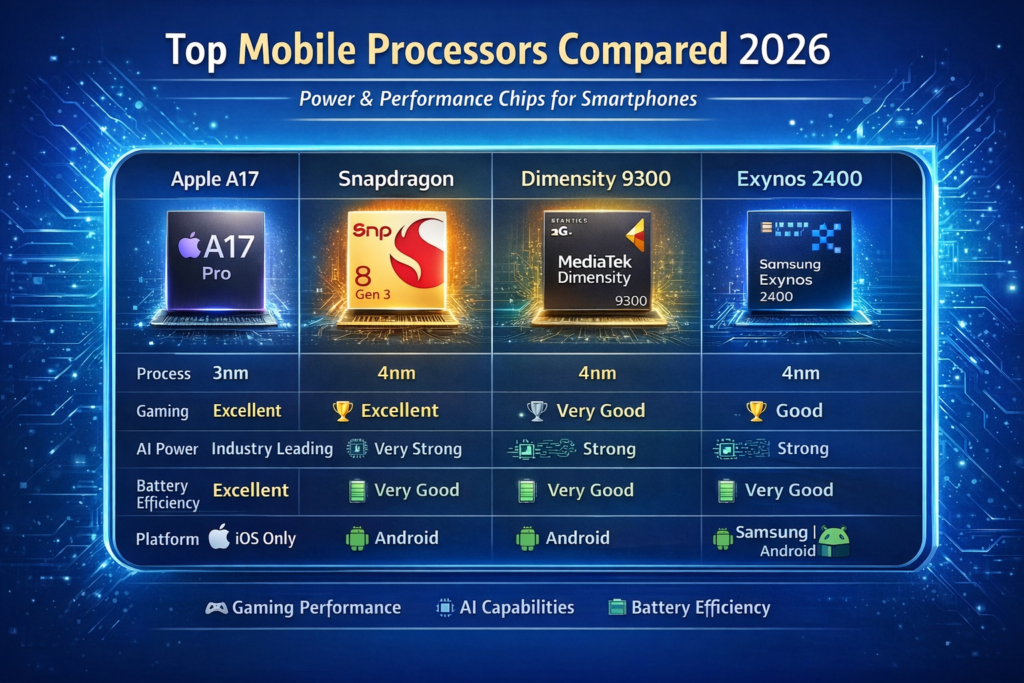
Processor Comparison (2026)
| Feature | Apple A17 Pro | Snapdragon 8 Gen 3 | Dimensity 9300 | Exynos 2400 |
|---|---|---|---|---|
| Process | 3nm | 4nm | 4nm | 4nm |
| Gaming | Excellent | Excellent | Very Good | Good |
| AI Power | Industry Leading | Very Strong | Strong | Strong |
| Battery Efficiency | Excellent | Very Good | Very Good | Good |
| Platform | iOS Only | Android | Android | Samsung |
Best Processor for Gaming?
If you play:
- PUBG Mobile
- Call of Duty
- Genshin Impact
Top choices:
- Apple A17 Pro
- Snapdragon 8 Gen 3
- Dimensity 9300
They provide:
- High FPS
- Stable performance
- Better heat control
Which Processor Gives Best Battery Life?
Battery life depends on:
- Chip efficiency (3nm/4nm)
- Software optimization
- Usage pattern
Generally:
- Apple chips = excellent optimization
- Snapdragon = strong balance
- Dimensity = improving rapidly
Best Processor for Budget Phones
Mid-range options like:
- Snapdragon 7 series
- Dimensity 8000/7000 series
Offer:
- Smooth daily usage
- Good gaming
- Strong battery life
Perfect for value-for-money buyers.
Future of Mobile Processors
In 2026 and beyond, expect:
- More AI-focused chips
- Better on-device AI processing
- More power-efficient 3nm & 2nm chips
- Console-level mobile gaming
Mobile processors are becoming almost as powerful as laptops.
Final Verdict: Which One Should You Choose?
👉 If you want the absolute best performance:
Apple A17 Pro or Snapdragon 8 Gen 3
👉 If you want strong gaming at competitive price:
Dimensity 9300
👉 If you want balanced performance:
Snapdragon flagship series
Remember: A processor alone doesn’t define a phone. Optimization, cooling system, and RAM also matter.