Imagine downloading a full HD movie in under a second… using nothing but the light from your ceiling lamp. No cables. No radio waves. Just pure, invisible flickers of light carrying gigabits of data. That’s LiFi — the wireless technology that’s quietly revolutionizing how we connect.
In 2026, LiFi is no longer a lab experiment. It’s deployed by the U.S. Army at scale, standardized by IEEE, and powering multi-gigabit connections in offices, hospitals, aircraft, and beyond. Here’s your complete, up-to-date guide.
What Exactly is LiFi?
LiFi (Light Fidelity) is a bidirectional wireless communication technology that transmits data using visible light, infrared, or ultraviolet from LED sources instead of radio frequencies (like WiFi).
- Invented/coined by Professor Harald Haas (University of Edinburgh) in his famous 2011 TED Talk.
- It’s a subset of Visible Light Communication (VLC).
- Core idea: Turn ordinary LED lights into high-speed data transmitters by flickering them billions of times per second — too fast for the human eye to notice.


How Does LiFi Work? (Simple Breakdown)
- Transmitter Side Your internet router feeds data to a LiFi-enabled LED driver. The LED modulates its light intensity (on/off or subtle brightness changes) to encode binary data (0s and 1s).
- Transmission Light travels at the speed of… well, light. The flickering carries your Netflix stream, Zoom call, or file download invisibly.
- Receiver Side A photodetector (tiny sensor in your phone, laptop dongle, or ceiling unit) picks up the light variations, converts them back into electrical signals, and decodes the data.
- Uplink (sending data back) Usually handled by infrared (IR) from your device or a second visible-light channel.
The entire process is full-duplex (simultaneous upload/download) and works with existing LED infrastructure.
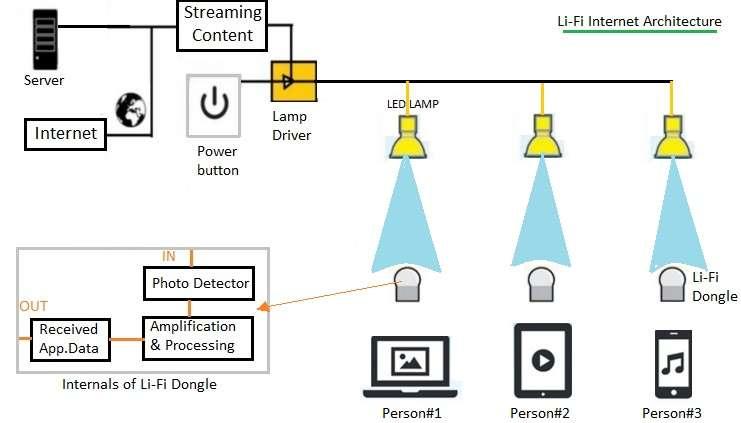
LiFi Dongle and Transceiver: Block Diagram and Working | RF Wireless World
LiFi vs WiFi: Head-to-Head Comparison (2026 Reality)
| Feature | LiFi | WiFi (WiFi 6E/7) |
|---|---|---|
| Transmission Medium | Visible/IR/UV light | Radio waves (2.4/5/6 GHz) |
| Speed | 1–10+ Gbps real-world; lab record 224 Gbps | Up to ~9.6 Gbps theoretical |
| Range | 10–20 meters (room-sized, light-dependent) | 30–100+ meters (through walls) |
| Security | Extremely high (light can’t pass walls) | Good with WPA3, but interceptable |
| Interference | None with RF; immune to electromagnetic noise | Crowded spectrum, interference common |
| Works in Darkness? | No (unless IR mode) | Yes |
| Health/Safety | No RF radiation concerns | Subject to ongoing EMF debates |
| Standard | IEEE 802.11bb (ratified 2023) | IEEE 802.11ax/be |
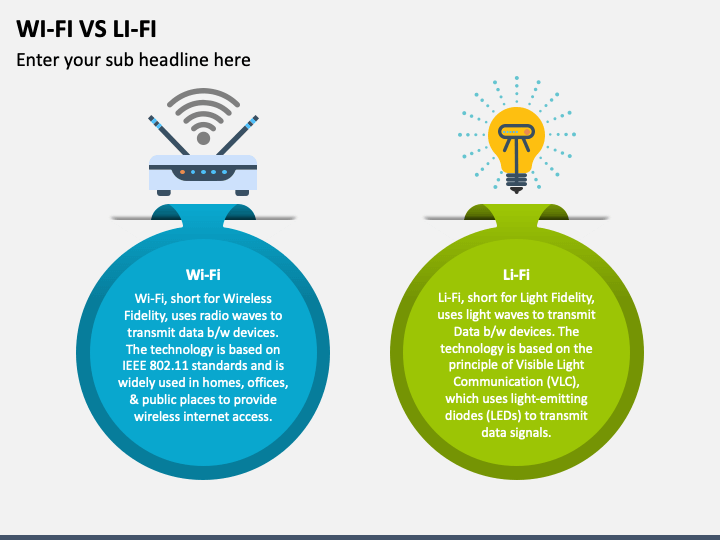
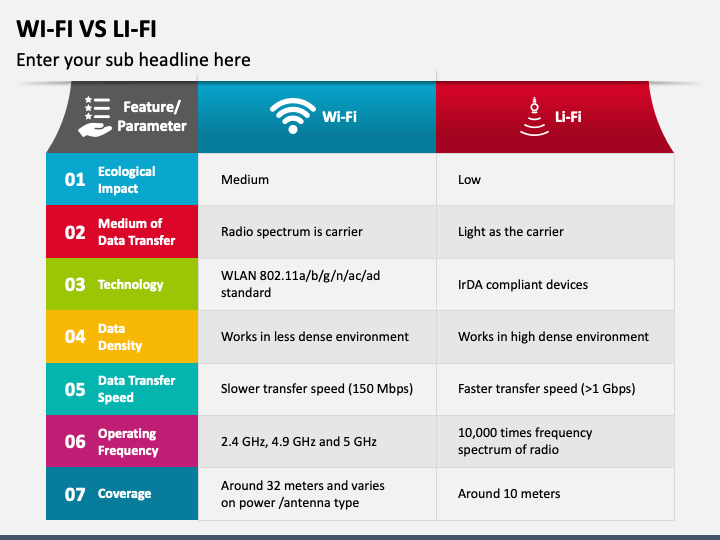
Bottom line: LiFi doesn’t replace WiFi — it complements it. Best of both worlds in hybrid systems.
Major Advantages of LiFi
- Blazing Speed & Bandwidth — Visible light spectrum is ~10,000× larger than radio spectrum.
- Military-Grade Security — Data stays inside the lit room. Perfect for defense, banks, hospitals.
- No RF Interference — Safe for aircraft cockpits, MRI rooms, oil rigs, factories with heavy machinery.
- Energy Efficient — Uses existing lighting infrastructure; LEDs do double duty (light + data).
- Precise Indoor Positioning — Accurate to centimeters (great for navigation in malls, warehouses).
- Green Technology — No additional hardware towers needed.
Limitations (Yes, There Are Some)
- Line-of-Sight / Light Dependency — Blocked by opaque objects; performance drops in bright sunlight.
- Range — Strictly room-scale (though reflections help).
- Uplink Challenges — Early systems needed separate IR; modern ones solve this.
- Maturity — WiFi has 25+ years head start; LiFi ecosystem still growing in 2026.
Real-World Applications & Deployments (2026)
- Defense — Largest-ever deployment: Thousands of pureLiFi Kitefin units with U.S. Army Europe & Africa (secure, RF-silent comms).
- Healthcare — RF-free zones in hospitals.
- Aviation — Cabin connectivity without interfering with navigation systems.
- Smart Offices & Homes — LiFi Cube™ and Kitefin XE deliver gigabit speeds from ceiling lights.
- Underwater & Industrial — Light works where radio fails.
- VR/AR & Gaming — Ultra-low latency + high bandwidth.
- IoT & Smart Cities — Billions of connected lights.
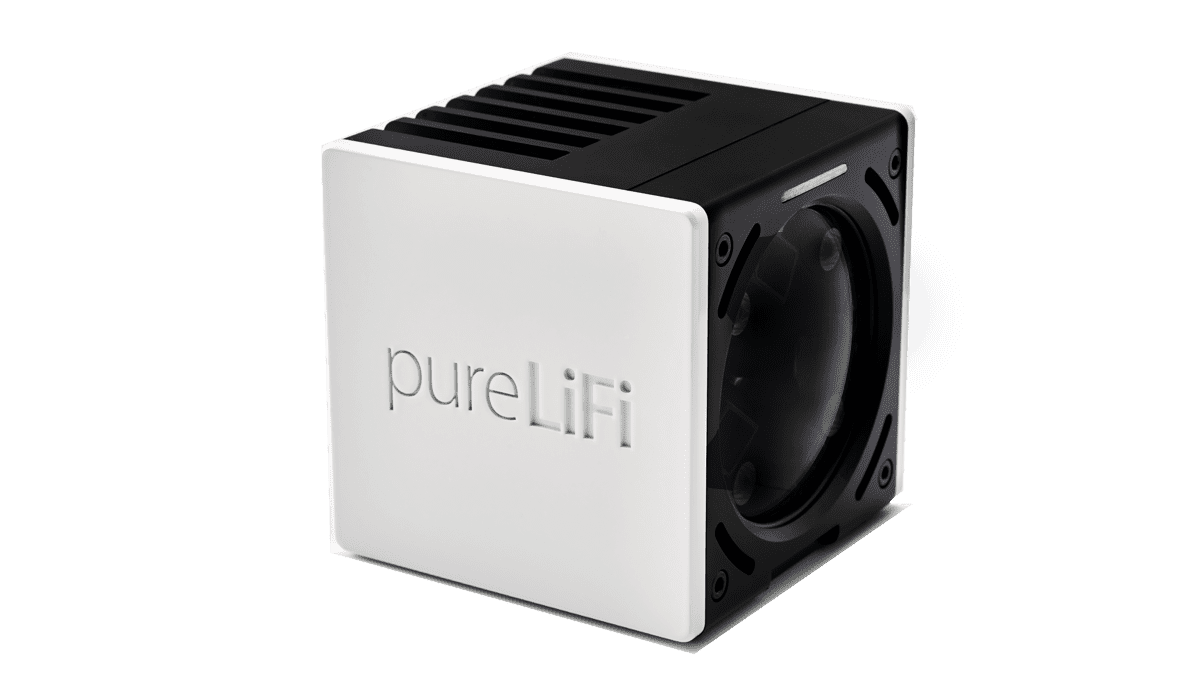

Current Products & Companies (2026)
pureLiFi (founded by Harald Haas) leads the market:
- LiFi Cube™ — Plug-and-play hotspot
- Kitefin XE / Tactical — Room-filling & military-grade
- Bridge XC™ — Brings outdoor 5G indoors via light
Other players: Oledcomm (France), Signify (Philips spin-off), and multiple Asian manufacturers.
IEEE 802.11bb standard (2023) ensures interoperability — just like WiFi.

IEEE’s Approval of 802.11bb Frequency as LiFi Standard | Oledcomm
The Future of LiFi: 2026 and Beyond
- Hybrid WiFi + LiFi networks becoming standard in enterprises.
- Smartphone integration — Expect LiFi receivers in flagship phones soon.
- 6G/7G synergy — LiFi handles indoor ultra-dense traffic; WiFi/5G/6G handles outdoor.
- Mass adoption in education, retail, and public spaces.
- CES 2026 & MWC demos already showing 10 Gbps real-world performance.
Professor Haas’s vision from 2011 — “Data through illumination” — is now reality.
Final Thoughts: Is LiFi Worth It?
If you need blazing speed, ironclad security, and RF-free operation in a specific space — yes, LiFi is ready today.
If you want blanket coverage anywhere — WiFi still wins.
The future isn’t LiFi or WiFi. It’s both, working together under the glow of LED lights.
Ready to light up your connection? Drop a comment: Where would you use LiFi first — home office, hospital, or airplane?
Sources & Further Reading: pureLiFi.com, IEEE 802.11bb, Harald Haas TED Talks, Oledcomm research (all current as of February 2026).
Let there be light… and data! 💡📡