Smartphones are getting more powerful — but battery life still struggles to keep up. Whether you’re traveling, working remotely, or dealing with load shedding, a power bank has become an essential gadget.
In this complete buying guide, we’ll cover capacity, charging speed, safety, compatibility, ports, and smart buying tips — so you don’t waste your money.
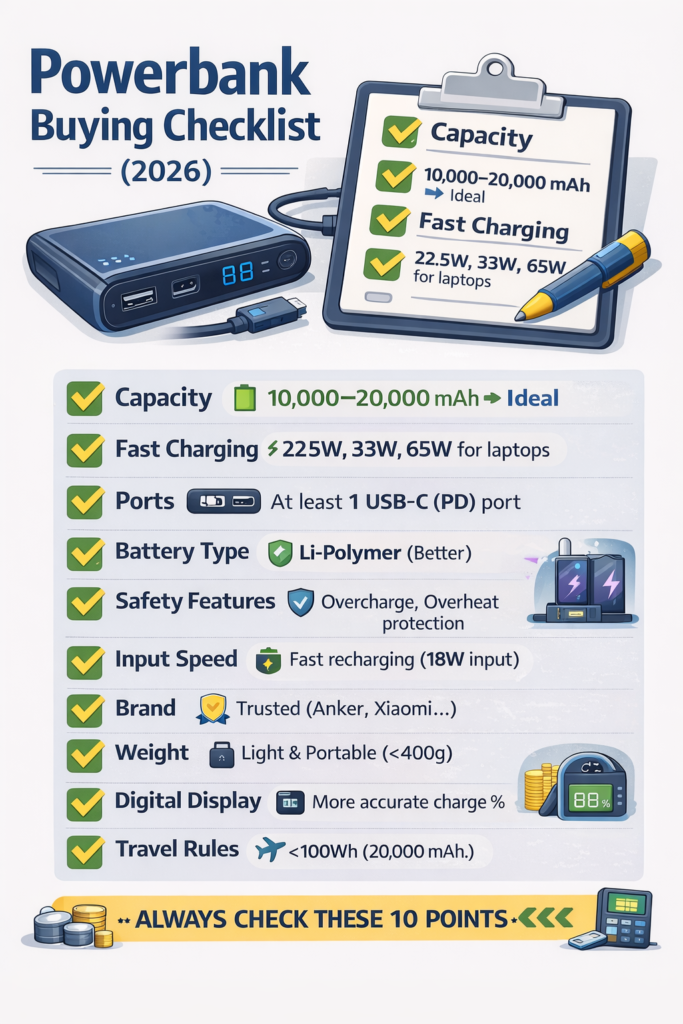
1) What Is a Power Bank?
A power bank is a portable battery that stores electrical energy and can charge your:
- Smartphone
- Tablet
- Smartwatch
- Earbuds
- Laptop (in some cases)
It works like a backup battery you can carry anywhere.
2) Understanding Capacity (mAh Explained)
The most important specification is capacity, measured in mAh (milliampere-hour).
Common Power Bank Capacities:
| Capacity | Best For |
|---|---|
| 5,000 mAh | Emergency top-ups |
| 10,000 mAh | Daily smartphone use |
| 20,000 mAh | Travel & heavy users |
| 30,000 mAh+ | Multiple devices & long trips |
Important:
You never get 100% output.
Due to energy conversion loss, actual usable capacity is about 60–75%.
For example:
- 10,000 mAh power bank → ~6,500–7,000 mAh real output.
Buying Tip:
If your phone has a 5,000 mAh battery, buy at least a 10,000 mAh power bank.
3) Fast Charging Support (Very Important in 2026)
Not all power banks support fast charging.
Look for these terms:
- PD (Power Delivery)
- QC (Quick Charge)
- 18W / 22.5W / 33W / 45W / 65W output
Why It Matters:
A normal 10W power bank may take 3–4 hours to charge your phone.
A 22.5W or 33W power bank can charge much faster.
Recommendation:
For modern Android and iPhone users:
- Minimum: 18W
- Ideal: 22.5W or 33W
- For laptops: 45W or 65W PD
4) Number & Type of Ports
Always check port types before buying.
Common Ports:
- USB-A (Traditional)
- USB-C (Modern & Fast Charging)
- Micro-USB (Older input)
- Lightning (Older iPhone input)
Best Option in 2026:
- At least 1 USB-C (PD) port
- 1–2 USB-A ports
- USB-C input for fast recharging
Avoid power banks that only support Micro-USB input.
5) Charging Speed (Input vs Output)
Many people ignore this.
- Output → How fast it charges your phone
- Input → How fast the power bank charges itself
If input is slow, your power bank may take 8–10 hours to recharge.
Good Specification:
- 18W or higher input support
- USB-C input preferred
6) Battery Type Inside Power Bank
There are two main battery types:
🔹 Lithium-Ion (Li-ion)
- Cheaper
- Slightly heavier
- Common in budget models
🔹 Lithium-Polymer (Li-Po)
- Lighter
- Slim design
- Safer
- More durable
Recommendation:
If budget allows, choose Li-Polymer.
7) Safety Features (Never Ignore This)
Cheap power banks can damage your phone.
Look for protection against:
- Overcharging
- Overheating
- Short circuit
- Over-voltage
- Over-current
Trusted brands include:
- Anker
- Xiaomi
- Samsung
- Baseus
- UGREEN
Avoid extremely cheap no-brand products.
8) Weight & Portability
Higher capacity = heavier power bank.
Approximate weights:
- 10,000 mAh → 180–250g
- 20,000 mAh → 350–450g
- 30,000 mAh → 500g+
If you travel daily, 10,000 or 20,000 mAh is ideal.
9) Can It Charge Laptops?
Not all power banks can charge laptops.
To charge laptops like:
- Apple MacBook
- Dell XPS
- HP Spectre
You need:
- USB-C PD
- Minimum 45W output
- Preferably 65W
Always check your laptop’s charging requirement.
10) Airline & Travel Rules
Most airlines allow power banks under 100Wh in cabin luggage.
Conversion formula:
(mAh × Voltage) ÷ 1000 = Wh
For example:
- 20,000 mAh at 3.7V ≈ 74Wh (Allowed)
Never pack power banks in checked luggage.
11) Digital Display vs LED Indicator
Some power banks show:
- LED dots (25%, 50%, 75%)
- Digital percentage display
Digital display is more accurate and convenient.
12) Extra Features You May Consider
- Wireless charging
- Built-in cable
- Magnetic (MagSafe-style)
- Pass-through charging
- LED flashlight
But don’t compromise on safety and fast charging.
How Much Should You Spend?
Budget range (2026 estimate):
- Basic 10,000 mAh → Affordable
- 20,000 mAh Fast Charging → Mid-range
- 65W Laptop Power Bank → Premium
Avoid suspiciously cheap options.
Which Power Bank Should You Buy?
Casual User:
10,000 mAh, 22.5W, USB-C
Heavy Smartphone User:
20,000 mAh, 33W fast charging
Traveler:
20,000 mAh with dual output
Laptop User:
20,000–30,000 mAh, 65W PD
Common Mistakes to Avoid
- Buying based only on mAh
- Ignoring fast charging support
- Not checking input speed
- Choosing unknown brands
- Ignoring airline limits
Final Verdict
In 2026, the ideal power bank should have:
✔️ At least 10,000–20,000 mAh
✔️ USB-C PD support
✔️ 22.5W or higher output
✔️ Safety protection features
✔️ Reputable brand
A good power bank is not just about capacity — it’s about efficiency, safety, and charging speed.