Torrents are one of the most misunderstood technologies on the internet. Many people associate them only with piracy — but in reality, BitTorrent is just a file-sharing protocol. It’s widely used for legal distribution of large files like Linux operating systems, games, and software updates.
In this detailed guide, you’ll learn:
- What torrents are
- How BitTorrent works step by step
- What seeds, peers, trackers, and magnet links mean
- Why torrents are fast
- Is torrenting legal?
Let’s break it down in simple terms.
1) What Is a Torrent?
A torrent is not the actual file.
It is a small file or magnet link that tells your computer:
- What file to download
- Where to find it
- Who else is sharing it
Torrenting uses peer-to-peer (P2P) technology instead of a central server.
2) Traditional Download vs Torrent Download
Normal Download (Client-Server Model)
You download a file from one central server.
Problem:
- If many people download at once → server slows down
- If server goes offline → download fails
Torrent Download (Peer-to-Peer Model)
Instead of one server:
- Every downloader also becomes an uploader
- Users share pieces of the file with each other
This creates a distributed network.
The more people downloading → the faster it can become.
3) Key Torrent Terms Explained
Understanding these words is important.
Seeder
A seeder is someone who:
- Has 100% of the file
- Is uploading it to others
More seeders = faster download.
Peer (Leecher)
A peer is someone who:
- Is downloading the file
- May also upload parts they already have
If someone downloads but stops sharing after completion, they are often called a “leecher.”
Swarm
The swarm is the entire group of:
- Seeders
- Peers
All sharing the same file.
Tracker
A tracker is a server that:
- Helps peers find each other
- Keeps track of who is downloading and uploading
Modern torrents also use decentralized tracking (DHT), so trackers are less important now.
Magnet Link
A magnet link is:
- A clickable link
- No need to download a .torrent file
It directly connects your torrent client to the swarm.
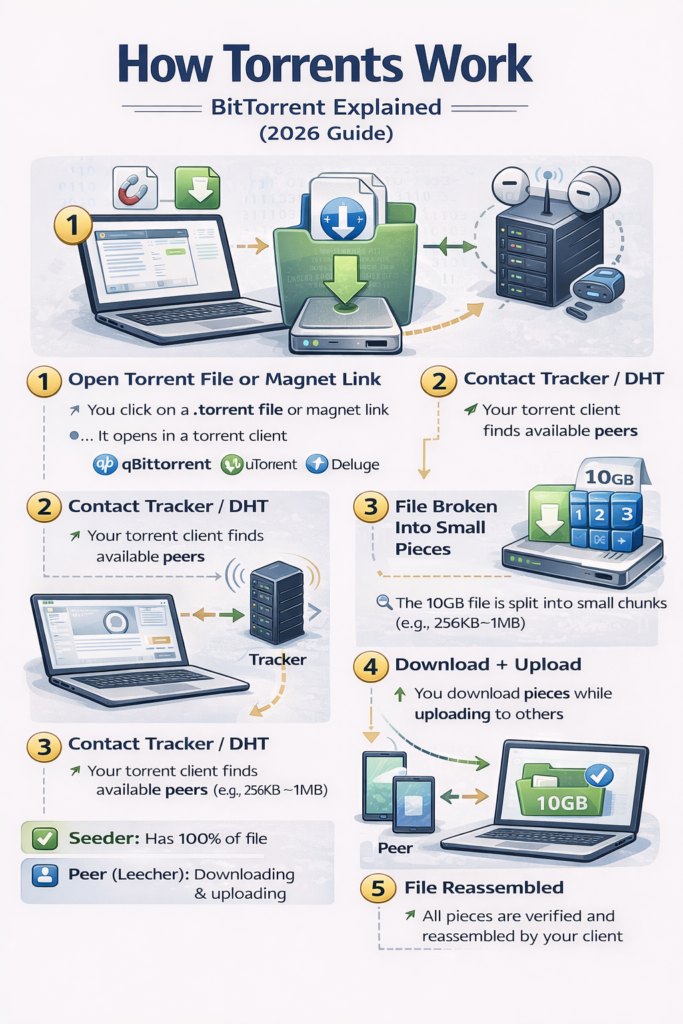
4) Step-by-Step: How BitTorrent Works
Let’s imagine you want to download a 10GB file.
Step 1: Open Torrent File or Magnet Link
You open it in a torrent client like:
- qBittorrent
- uTorrent
Step 2: Client Contacts Tracker or DHT
Your client finds:
- Available seeders
- Other peers
Step 3: File Is Broken into Pieces
The file is divided into small chunks (for example 256KB–4MB each).
You don’t download it from one person.
You download:
- Piece 1 from Peer A
- Piece 2 from Peer B
- Piece 3 from Seeder C
All at the same time.
Step 4: You Start Uploading Too
As soon as you download a piece:
You automatically share that piece with others.
This makes the network faster.
Step 5: File Reassembled
After all pieces are downloaded:
Your client verifies integrity and rebuilds the full file.
5) Why Torrents Are So Fast
Torrents can be faster than direct downloads because:
- Multiple upload sources
- Distributed load
- No single server bottleneck
If 1000 people share a file, you can download from many of them simultaneously.
6) Is Torrenting Legal?
Important distinction:
BitTorrent Technology = Legal
It is just a file-sharing protocol.
Downloading Copyrighted Content = Illegal (in many countries)
Many legal uses include:
- Linux distributions (like Ubuntu)
- Game patches
- Large software updates
- Public domain media
Always follow your country’s laws.
7) What Is DHT (Distributed Hash Table)?
DHT allows torrent clients to:
- Find peers without a central tracker
- Work even if tracker is offline
It makes BitTorrent more decentralized.
8) What Is Seeding Ratio?
Your ratio = Upload ÷ Download.
Example:
- Downloaded 10GB
- Uploaded 15GB
- Ratio = 1.5
Private torrent communities often require good ratios.
9) Risks of Torrenting
Malware
Some torrents contain viruses.
Fake Files
Incorrect or misleading files.
IP Exposure
Your IP address is visible to peers.
Do People Use VPNs?
Some users use VPNs to:
- Hide IP address
- Protect privacy
But always check local laws before doing anything.
10) Advantages of BitTorrent
✔ Efficient large file distribution
✔ Reduces server costs
✔ No central failure point
✔ Scales automatically
11) Disadvantages
❌ Can spread pirated content
❌ Requires upload bandwidth
❌ Speeds depend on seeders
Quick Summary Table
| Feature | Traditional Download | Torrent |
|---|---|---|
| Source | Single Server | Multiple Peers |
| Speed | Limited by server | Can be very fast |
| Server Cost | High | Low |
| Failure Risk | Server crash | Very low |
| Legal Risk | Depends on content | Depends on content |
Final Verdict
BitTorrent is a smart, decentralized file-sharing system.
It works by:
- Splitting files into pieces
- Sharing between users
- Removing the need for a central server
The technology itself is powerful and legal.
What matters is how you use it.