If you’ve ever checked smartphone specs, power banks, drones, or laptops, you’ve likely seen Li-ion or Li-Po batteries mentioned. But what exactly is the difference between them? And which one is better?
Let’s break it down in simple but detailed terms.
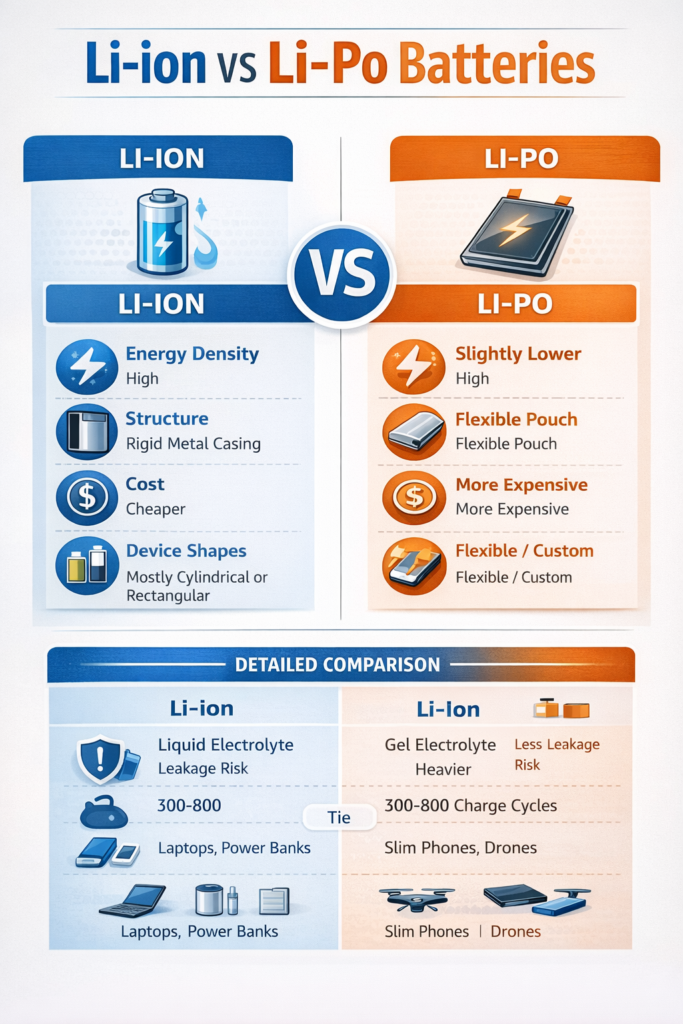
What is a Li-ion Battery?
Lithium-ion (Li-ion) batteries are rechargeable batteries that use a liquid electrolyte to move lithium ions between the cathode and anode.
They became popular in the 1990s and are still widely used today.
Common Devices Using Li-ion:
- Laptops
- Budget smartphones
- Power banks
- Electric vehicles
Li-ion batteries are known for:
- High energy density
- Long lifespan
- Affordable manufacturing
What is a Li-Po Battery?
Lithium-polymer (Li-Po) batteries are a type of lithium battery that uses a polymer (gel-like) electrolyte instead of liquid.
They are technically a subtype of lithium-ion batteries but with different construction.
Common Devices Using Li-Po:
- Flagship smartphones
- Drones
- Slim laptops
- Wearables
Li-Po batteries are known for:
- Flexible shapes
- Slim designs
- Lightweight build
Core Technical Difference
| Feature | Li-ion | Li-Po |
|---|---|---|
| Electrolyte | Liquid | Polymer (Gel) |
| Structure | Rigid metal casing | Flexible pouch |
| Shape | Mostly cylindrical or rectangular | Custom shapes possible |
The biggest difference is design flexibility.
Why Smartphones Mostly Use Li-Po Now?
Modern phones like:
- iPhone 15 Pro
- Samsung Galaxy S24 Ultra
- Google Pixel 8 Pro
Use Li-Po batteries because:
- Phones are getting thinner
- Internal components require custom battery shapes
- Lightweight materials are preferred
- Safety and heat management are improved
Li-ion vs Li-Po – Detailed Comparison
1) Energy Density
- Li-ion: Slightly higher energy density
- Li-Po: Slightly lower, but difference is minimal today
👉 Winner: Li-ion (slightly)
2) Design Flexibility
- Li-ion: Fixed shapes
- Li-Po: Can be ultra-thin, curved, or custom-shaped
👉 Winner: Li-Po
3) Safety
- Li-ion: Risk of leakage if damaged
- Li-Po: More resistant to leakage due to gel electrolyte
However, both can swell or catch fire if damaged.
👉 Winner: Li-Po (slightly safer design)
4) Cost
- Li-ion: Cheaper to manufacture
- Li-Po: More expensive
👉 Winner: Li-ion
5) Weight
- Li-ion: Heavier due to metal casing
- Li-Po: Lighter due to pouch design
👉 Winner: Li-Po
6) Lifespan (Charge Cycles)
Both typically last:
- 300–800 full charge cycles
- 2–4 years average lifespan
No major difference in real-world use.
👉 Winner: Tie
Swelling Issue – Which One Swells More?
Both battery types can swell due to:
- Overcharging
- Heat exposure
- Manufacturing defects
- Aging
However:
- Li-Po swelling is more noticeable because of pouch design.
- Li-ion swelling may be less visible due to rigid casing.
Neither is immune.
Fast Charging Support
Both Li-ion and Li-Po support:
- 45W+
- 67W
- 120W fast charging (depending on design)
Fast charging depends more on:
- Battery management system (BMS)
- Cooling system
- Charger technology
Not strictly on Li-ion vs Li-Po type.
What About Electric Vehicles?
Companies like:
- Tesla
Primarily use advanced lithium-ion battery chemistries (like NCA or LFP variants), not typical consumer Li-Po pouch batteries.
EV batteries are highly engineered and very different from smartphone batteries.
Which One is Better in 2026?
Choose Li-ion If:
- You want lower cost
- It’s a laptop or power bank
- Weight and thickness are not critical
Choose Li-Po If:
- It’s a slim smartphone
- You need lightweight devices
- Space optimization matters
In reality, as a consumer, you usually don’t choose — manufacturers decide based on product design.
Final Verdict
There is no “better” battery overall.
- Li-ion = More affordable + Slightly higher energy density
- Li-Po = Slimmer + Lighter + Flexible design
For smartphones in 2026, Li-Po dominates because modern designs require thin and compact internal layouts.
For laptops, EVs, and larger electronics, Li-ion remains widely used due to cost and scalability.
FAQ Section
❓ Is Li-Po battery better than Li-ion?
Not necessarily. Li-Po is better for slim designs, while Li-ion is better for cost efficiency.
❓ Which battery lasts longer?
Both last 2–4 years depending on usage and charging habits.
❓ Is Li-Po safer?
Slightly safer in terms of leakage, but both can be dangerous if damaged.