In 2026, the mobile landscape has shifted. The days of MediaTek being the “budget-only” option and Qualcomm being the “flagship king” are over. MediaTek has aggressively pushed into the premium space with its Dimensity 9000 series, while Qualcomm has reinvented its chips with the custom Oryon architecture.
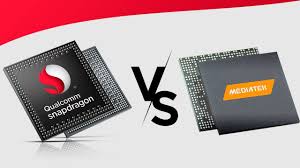
If you’re choosing a phone today, here is the state of the rivalry between the Snapdragon 8 Elite (Gen 5) and the Dimensity 9500.
2026 Flagship Comparison: Snapdragon vs. Dimensity
| Feature | Qualcomm Snapdragon 8 Elite (Gen 5) | MediaTek Dimensity 9500 |
| CPU Architecture | Custom Oryon Gen 3 (High Clock) | “All-Big-Core” (Cortex-C1 Series) |
| Peak Speed | 4.6 GHz (Industry Leading) | 4.21 GHz |
| GPU | Adreno 840 (Better Sustained Gaming) | Mali G1-Ultra (Higher Peak Ray Tracing) |
| AI NPU | Hexagon (Advanced On-Device Models) | NPU 990 (Efficient 4K Image Gen) |
| Best For | Power Users, Hardcore Gaming, US Users | Multitaskers, Battery Life, Global Value |
1. Performance: Raw Power vs. Multicore Efficiency
Qualcomm’s big move in 2026 was ditching standard ARM designs for their custom Oryon cores. This allows the Snapdragon 8 Elite to hit a massive 4.6 GHz clock speed. In real-world use, this makes the phone feel incredibly snappy—apps open instantly, and the UI never hitches.+1
MediaTek, on the other hand, uses an “All-Big-Core” design. Instead of mixing fast cores with tiny “efficiency” cores, the Dimensity 9500 uses only powerful cores.
- The Result: Snapdragon usually wins in single-core speed (best for gaming and daily fluidity), while MediaTek often wins in multi-core tests (best for exporting video or heavy multitasking).
2. Gaming: The Stability War
For years, Qualcomm’s Adreno GPU has been the gold standard because game developers optimize for it first. In 2026, that still holds true. While MediaTek’s Mali GPU can hit impressive benchmark numbers, Snapdragon typically offers better thermal stability.
Note: MediaTek chips can sometimes heat up faster during long (2+ hour) gaming sessions, leading to “throttling” (where the phone slows down to cool off). Snapdragon’s efficiency improvements this year have made it the better choice for marathon sessions of Genshin Impact or Warzone Mobile.
3. Camera & AI: The “Brain” of the Phone
The processor handles all the “magic” your camera does.
- Snapdragon: Known for its Spectra ISP, which is world-class at skin tone accuracy and 8K HDR video recording. It’s why almost every “Best Camera Phone” (like the Samsung Ultra or Google Pro series) typically uses Snapdragon.
- MediaTek: Its Imagiq 1190 ISP has caught up significantly, especially in low-light photography. It also features incredible AI-driven “agentic” capabilities, allowing your phone to automate tasks like summarizing meetings or editing photos with voice commands.
4. Connectivity and Availability
If you are in the United States, Qualcomm is almost always the winner due to its superior integration with 5G mmWave networks. MediaTek dominates the global market (Europe, Asia, India) because they offer flagship-level performance at a slightly lower price point to manufacturers.
The Verdict: Which should you choose?
Choose Qualcomm Snapdragon if…
- You want the absolute fastest single-core performance.
- You are a serious gamer who plays for hours at a time.
- You want the most reliable camera and video processing.
Choose MediaTek Dimensity if…
- You want maximum value (flagship speed for $100–$200 less).
- You prioritize battery life and efficient multitasking.
- You want a phone that stays cool during standard daily tasks like browsing and streaming.
Are you looking at a specific phone model right now? Tell me which one, and I can tell you exactly which chip is inside and how it stacks up!