How E-Ink Displays Work: Explained in Detail
In a world dominated by glowing screens from smartphones to laptops, E-ink displays stand out as a refreshing alternative. You’ve probably encountered them in e-readers like the Amazon Kindle, where the screen looks remarkably like printed paper. But how do these displays achieve that paper-like quality while sipping minimal power? In this blog post, we’ll dive deep into the science and engineering behind E-ink technology, breaking it down step by step.
A Brief History of E-Ink
E-ink, short for electronic ink, was pioneered in the late 1990s by companies like E Ink Corporation (based in Cambridge, MA) and Xerox in Palo Alto, CA. The goal was to create a display that combined the readability of paper with the flexibility of digital content. E Ink Corporation, now a leader in the field, commercialized the technology, leading to its widespread adoption in devices like e-readers and electronic shelf labels. The first major breakthrough came with the Sony Librie in 2004, but it was the Amazon Kindle in 2007 that truly popularized E-ink.
The Core Technology: Microcapsules and Electrophoresis
At the heart of an E-ink display is a phenomenon called electrophoresis—the movement of charged particles in a fluid under an electric field. Imagine millions of tiny spheres, each about the diameter of a human hair (roughly 100 micrometers), suspended in a thin film. These are called microcapsules.
Inside each microcapsule is a clear fluid containing two types of pigment particles:
- Positively charged white particles (often made of titanium dioxide).
- Negatively charged black particles (typically carbon-based).
These particles are electrically charged and can move freely within the fluid but are trapped inside the capsule. The capsules are arranged in a layer between two electrodes: a transparent top electrode and a bottom electrode embedded in a flexible plastic sheet.
Here’s a visual breakdown of a single microcapsule:
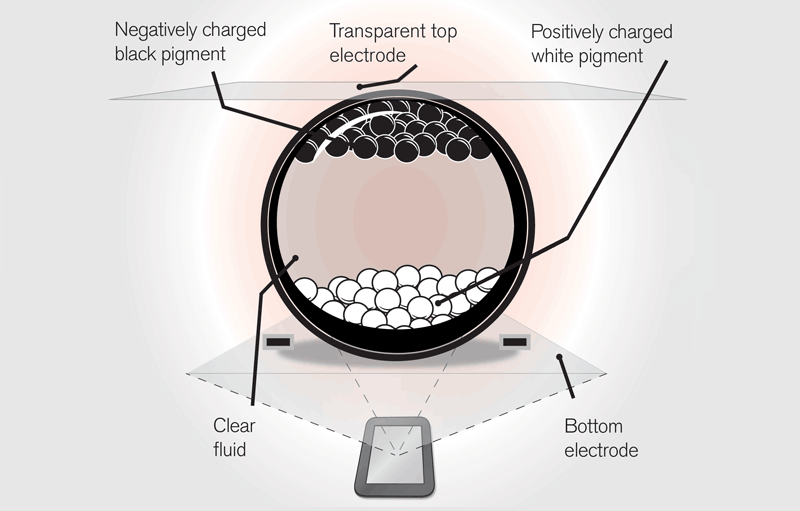
Electronic paper explained: what is it and how does it work? – Visionect
When no electric field is applied, the particles are dispersed randomly. But apply a voltage, and magic happens:
- A positive electric field at the top electrode attracts the negatively charged black particles to the top, making the capsule appear black from above.
- A negative electric field pushes the black particles to the bottom and pulls the white ones up, making it appear white.
This process is bistable, meaning once the particles move, they stay in place even without power—much like ink on paper doesn’t fade when you close a book. That’s why E-ink only consumes energy when changing the image, leading to battery life measured in weeks rather than hours.
Forming Images: From Pixels to Pages
An E-ink screen is essentially a grid of these microcapsules, each acting as a pixel (or sub-pixel in color versions). The display is wired with microelectronics that control the charge on each electrode independently. To display text or images:
- The device’s processor calculates the desired pattern.
- It applies precise voltages to the grid of electrodes.
- Particles in each microcapsule rearrange accordingly.
- The result is a high-contrast image visible in ambient light, as E-ink is reflective—it bounces back environmental light like real paper, without needing a backlight.
Grayscale is achieved by varying the number of particles at the top or using dithering techniques, where patterns of black and white pixels create shades. Modern E-ink displays can render up to 16 levels of gray for smooth gradients.
For color E-ink (like in the Kindle Colorsoft or advanced signage), additional pigments (red, yellow) are added to microcapsules, or color filters are layered over black-and-white ones. However, color versions are still less vibrant than LCDs and slower to refresh.
Advantages of E-Ink Over Traditional Displays
E-ink shines in scenarios where readability and efficiency matter most. Here’s a quick comparison with LCD screens:
| Feature | E-Ink Displays | LCD Displays |
|---|---|---|
| Power Consumption | Extremely low; only uses power to change images | Constant power for backlight and refresh |
| Readability | Excellent in direct sunlight; no glare | Prone to glare; requires backlight |
| Eye Strain | Minimal, like reading paper | Higher due to blue light and flicker |
| Refresh Rate | Slow (0.5-1 second per page) | Fast (60+ Hz for smooth video) |
| Color Capability | Limited (grayscale or muted colors) | Full vibrant colors |
| Durability | Flexible and robust | Fragile glass panels |
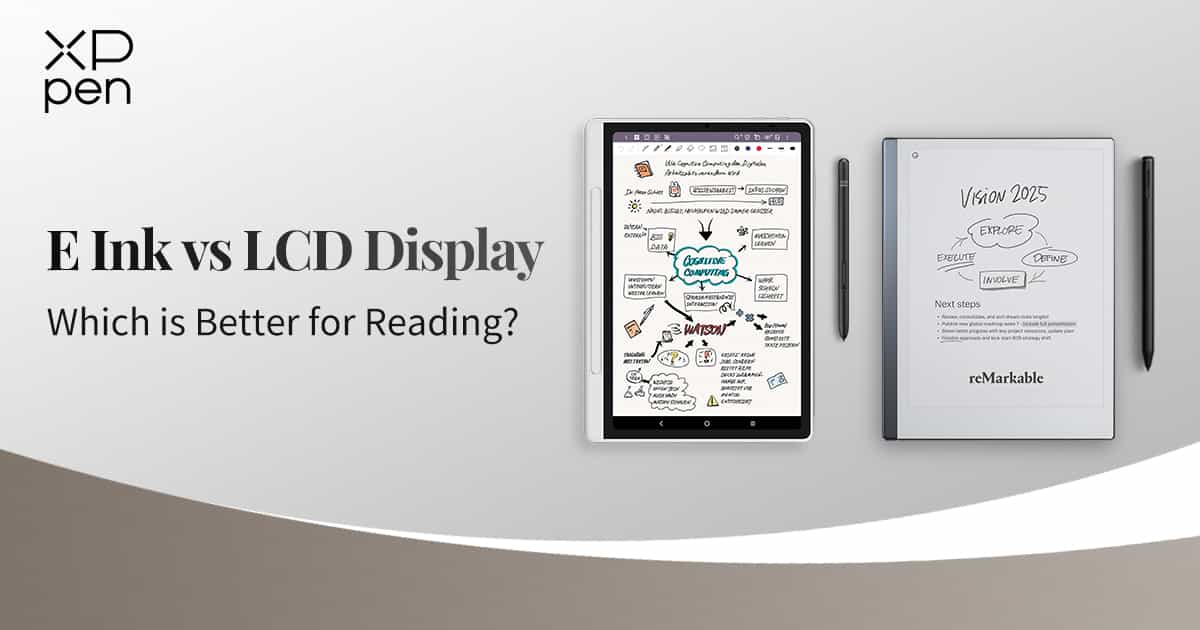
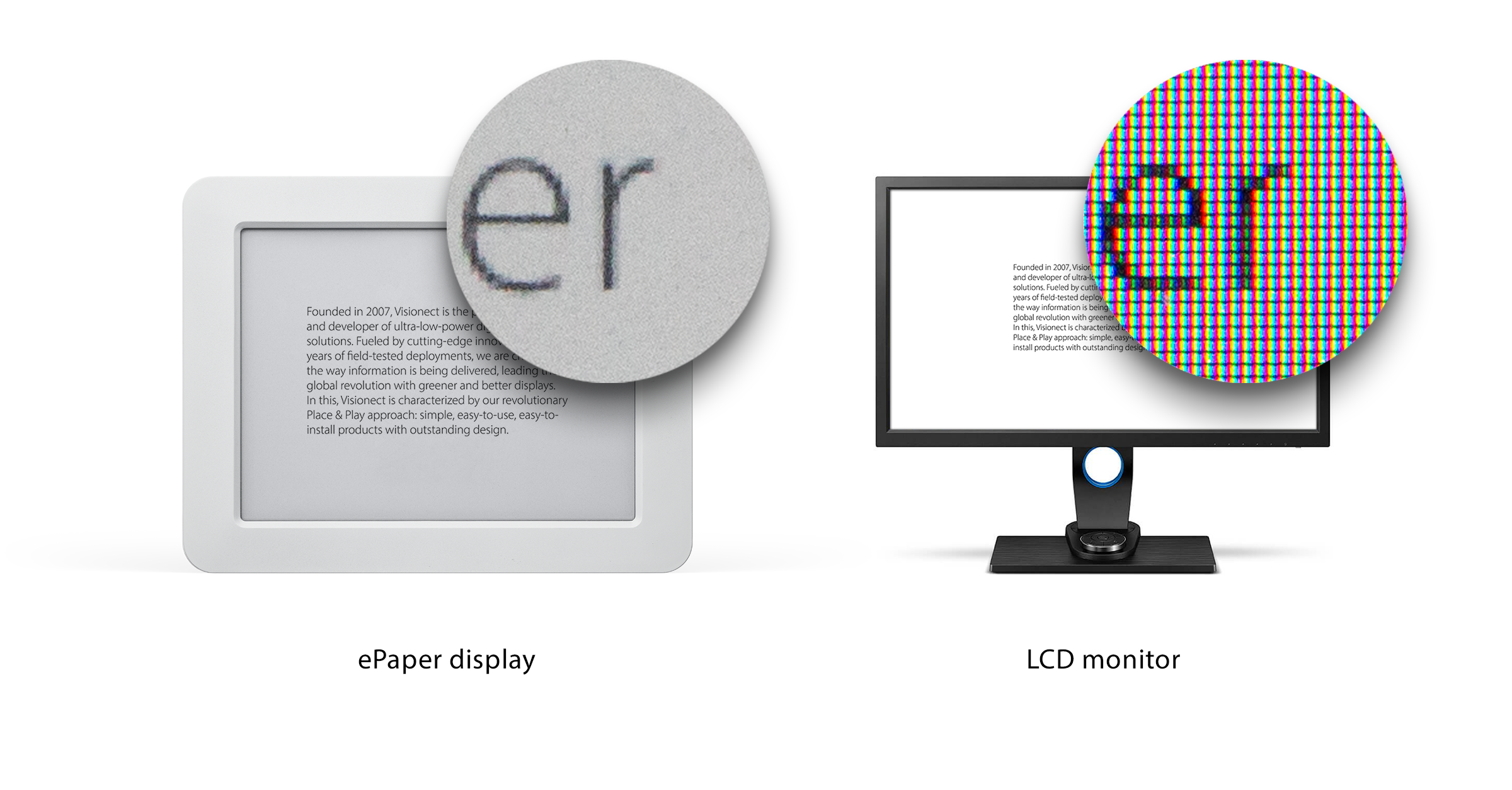
The reflective nature eliminates the need for backlighting, reducing eye strain and making it ideal for long reading sessions. Plus, its low power draw allows devices to run on small batteries for extended periods.
Disadvantages and Limitations
No technology is perfect. E-ink’s slow refresh rate makes it unsuitable for video or fast-scrolling apps—page turns often involve a brief “flash” to reset particles. Color reproduction is still evolving, and displays can suffer from ghosting (faint remnants of previous images) if not refreshed properly. Manufacturing costs are higher for large panels, limiting widespread use beyond e-readers.
Real-World Applications
E-ink is most famous in e-readers like the Kindle, where the screen mimics a book’s page for immersive reading.

Amazon.com: Paperwhite 16GB, HD Ink Screen E Reader, 6inch 800×600 E Reader E Book, Eye E Reader Devices Support TXT DOC PDF FB2 HTML PDB EPUB MOBI RTF (16GB) : Electronics
But its uses extend to:
- Smartwatches and wearables: For always-on displays without draining the battery.
- Electronic signage: Low-power billboards and price tags in stores.
- Note-taking devices: Like the reMarkable tablet, combining E-ink with stylus input.
- Emerging tech: Flexible E-ink for foldable phones or smart labels.
The Future of E-Ink
Advancements are pushing E-ink forward. Companies are developing faster-refreshing panels, full-color versions with thousands of hues, and even foldable displays. With growing demand for energy-efficient tech, E-ink could expand into education, healthcare (e.g., digital charts), and IoT devices.
In summary, E-ink displays blend chemistry, physics, and electronics to create a paper-like experience that’s efficient and easy on the eyes. Whether you’re a book lover or a tech enthusiast, understanding this technology reveals why it’s revolutionizing how we read and interact with digital content. If you’ve used an E-ink device, share your thoughts in the comments!