Is Your Smartphone Listening to You? Online Ads Tracking Explained
You talk about shoes with a friend…
Open Instagram five minutes later…
And boom — shoe ads everywhere.
Creepy, right?
This experience has led millions of people to ask the same question:
Is my smartphone secretly listening to me?
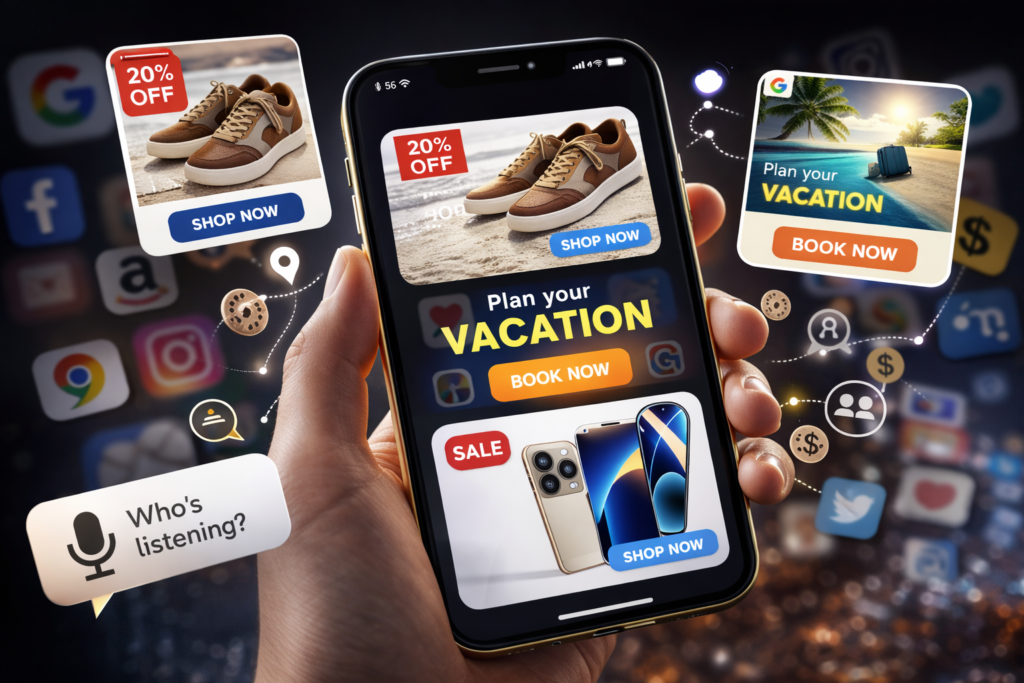
The short answer might surprise you — but the real explanation is even more fascinating (and a little scary).
Let’s break it down in simple terms.
Is Your Phone Actually Listening to Your Conversations?
Despite popular belief, there is no solid evidence that smartphones constantly listen to your private conversations to show ads.
Big companies like Google, Apple, and Meta have publicly stated that:
- They do not record conversations for ad targeting
- Continuous audio recording would drain battery and violate app store policies
- Such behavior would likely be exposed by security researchers
So why does it feel like your phone knows what you just talked about?
The Real Reason: You’re Being Tracked — Just Not How You Think
Your phone doesn’t need to listen to you when it already knows a lot about you.
Here’s how online ad tracking really works:
1. Location Tracking
Your smartphone constantly shares location data (with permission):
- GPS
- Wi-Fi networks
- Bluetooth devices
- Nearby shops and places
Example:
- You visit a mall
- Walk past a shoe store
- Later, shoe ads appear
No microphone needed.
2. Search History & Browsing Activity
Even one small action can trigger ads:
- Searching for a product
- Visiting a related website
- Watching a YouTube video
- Clicking a product link once
Ad platforms connect the dots instantly.
3. Social & Contact Connections
This one shocks people.
If:
- You talk to a friend about buying a phone
- That friend searches for phones
- You both share location or contacts
You may see similar ads.
Advertisers use “people like you” data — not individual spying.
4. App Permissions (The Silent Factor)
Many apps request access to:
- Location
- Contacts
- Camera
- Microphone (for features, not ads)
While microphones are usually used for:
- Voice messages
- Video calls
- Voice search
Poorly designed or shady apps can misuse permissions, which is why app permissions matter a lot.
5. AI Prediction Is Scarily Accurate
Modern ad systems don’t react — they predict.
Using AI, platforms can guess:
- What you’ll buy next
- When you’re planning a trip
- If you’re changing jobs
- If you’re interested in fitness, phones, or fashion
So when you think your phone heard you — it probably just predicted you.
6. Cookies & Cross-Device Tracking
Ever searched something on your laptop and saw ads on your phone?
That’s because:
- Devices are linked via accounts
- Cookies track activity
- Same Wi-Fi networks connect behavior
It feels like spying — but it’s data matching.
What About Apple vs Android?
Apple
- Stronger privacy controls
- App Tracking Transparency (ATT)
- Limits ad personalization
Android
- More customizable
- Ads can be controlled but require manual settings
- Google relies heavily on ad data
Neither platform openly listens to conversations — but both collect data.
How to Reduce Ad Tracking (Important)
If you care about privacy, do this:
- Review app permissions regularly
- Turn off ad personalization
- Disable background location for most apps
- Avoid shady free apps
- Use privacy-focused browsers
- Clear cookies often
You won’t eliminate tracking completely — but you can reduce it.
To Conclude
So… is your smartphone listening to you?
👉 No, not actively.
👉 Yes, it knows a lot about you.
The real issue isn’t microphones — it’s data, AI, and prediction systems working together to understand your behavior better than you realize.
In today’s digital world, you are the product — unless you take control of your privacy.