If you’ve ever tapped your phone on a payment machine and the transaction completed instantly — you’ve used NFC.
NFC is one of the most important technologies inside modern smartphones. From contactless payments using Apple Pay and Google Pay to wireless pairing and smart access cards, NFC is quietly powering everyday convenience.
Let’s break it down in simple terms.
What is NFC?
NFC (Near Field Communication) is a short-range wireless communication technology that allows two devices to exchange data when they are placed very close to each other (usually within 4 cm).
Think of it like:
A digital handshake between two devices.
Unlike Bluetooth, NFC:
- Works instantly
- Doesn’t require manual pairing
- Uses very low power
How Does NFC Work?
NFC works using radio frequency identification (RFID) technology.
Here’s what happens:
- Two NFC-enabled devices come close together.
- A small magnetic field is created.
- Data is transmitted securely between the devices.
- The transaction completes in seconds.
NFC operates at 13.56 MHz frequency and transfers data at speeds up to 424 kbps.
Types of NFC Modes
There are three main NFC operating modes:
1️⃣ Reader/Writer Mode
Your phone reads data from NFC tags.
Example:
- Scanning smart posters
- Reading contactless cards
2️⃣ Peer-to-Peer Mode
Two devices exchange data.
Example:
- Android Beam (older feature)
- Sharing small files
3️⃣ Card Emulation Mode
Your phone acts like a debit or credit card.
Example:
- Paying via Apple Pay
- Paying via Samsung Pay
This is the most common use today.
Main Uses of NFC
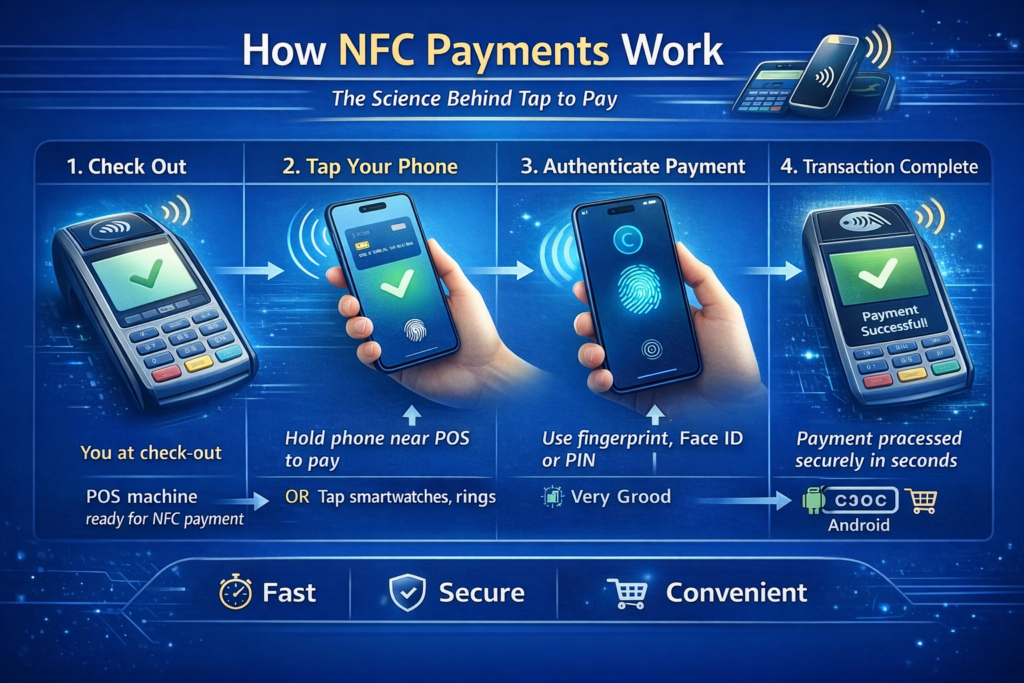
1️⃣ Contactless Payments
The most popular use.
You:
- Tap your phone on a POS machine
- Authenticate with fingerprint or Face ID
- Payment is completed
It’s fast, secure, and convenient.
2️⃣ Public Transport Cards
Many cities allow:
- Tap-to-enter metro
- Tap-to-pay bus fares
Your smartphone replaces physical travel cards.
3️⃣ Smart Access & Security
NFC is used for:
- Hotel room keys
- Office entry badges
- Smart door locks
Just tap your phone to unlock.
4️⃣ Data Sharing
Earlier Android phones supported file sharing through NFC (Android Beam).
Though Bluetooth and Wi-Fi Direct are now more common, NFC still helps initiate quick pairing.
5️⃣ Wireless Pairing
Tap your phone to:
- Pair Bluetooth headphones
- Connect to speakers
- Connect to smart devices
Example:
Tap-enabled pairing in premium audio devices.
6️⃣ NFC Tags & Automation
Small programmable NFC stickers can:
- Turn on WiFi
- Open apps
- Change phone settings
- Trigger smart home actions
Useful for automation lovers.
Is NFC Safe?
Yes, NFC is generally very secure because:
✔ Very short range (less risk of interception)
✔ Tokenized payment systems
✔ Biometric authentication required
✔ Encrypted communication
For example, mobile wallets like Google Pay use tokenization so your real card number is never shared.
NFC vs Bluetooth vs QR Code
| Feature | NFC | Bluetooth | QR Code |
|---|---|---|---|
| Range | Very Short | Medium | Depends on camera |
| Speed | Instant | Moderate | Moderate |
| Setup | No pairing | Pairing required | Scan required |
| Best For | Payments | Audio devices | Merchant payments |
Does NFC Drain Battery?
No. NFC consumes very little power because:
- It activates only when near another NFC device.
- It transfers small amounts of data.
You can keep it ON without noticeable battery drain.
Why NFC is Important in 2026
With the growth of:
- Digital wallets
- Smart homes
- Contactless payments
- IoT devices
NFC is becoming more essential than ever.
In many countries, people now leave home without wallets — just a smartphone.
Final Thoughts
NFC is a simple yet powerful technology that enables fast, secure, and contactless communication between devices. From mobile payments to smart automation, it has become a core feature of modern smartphones.
If your phone supports NFC, you’re carrying a digital wallet, access card, and smart automation tool — all in one device.