What is Noise Cancellation and How Does It Work?
In today’s fast-paced world, noise is everywhere — traffic, office chatter, airplane engines, and even the hum of fans. That’s where Noise Cancellation technology comes in. Whether you’re using premium headphones like Sony WH-1000XM5 or popular earbuds like Apple AirPods Pro, noise cancellation can dramatically improve your listening experience.
Let’s understand what noise cancellation is and how it actually works
What is Noise Cancellation?
Noise cancellation (or noise cancelling) is a technology used in headphones and earbuds to reduce or eliminate unwanted external sounds. It allows you to focus on your music, calls, or work without distractions.
There are two main types of noise cancellation:
- Passive Noise Cancellation
- Active Noise Cancellation (ANC)
1) Passive Noise Cancellation (Noise Isolation)
Passive noise cancellation doesn’t use any electronics. Instead, it physically blocks outside sound using:
- Thick ear cushions
- Tight ear seals
- In-ear silicone tips
Think of it like closing a door to block outside noise. Over-ear headphones naturally provide better passive isolation because they cover your entire ear.
📌 Example: Basic wired headphones or studio headphones mainly rely on passive isolation.
2) Active Noise Cancellation (ANC)
Active Noise Cancellation is more advanced and uses electronic technology to cancel noise.
How Does ANC Work?
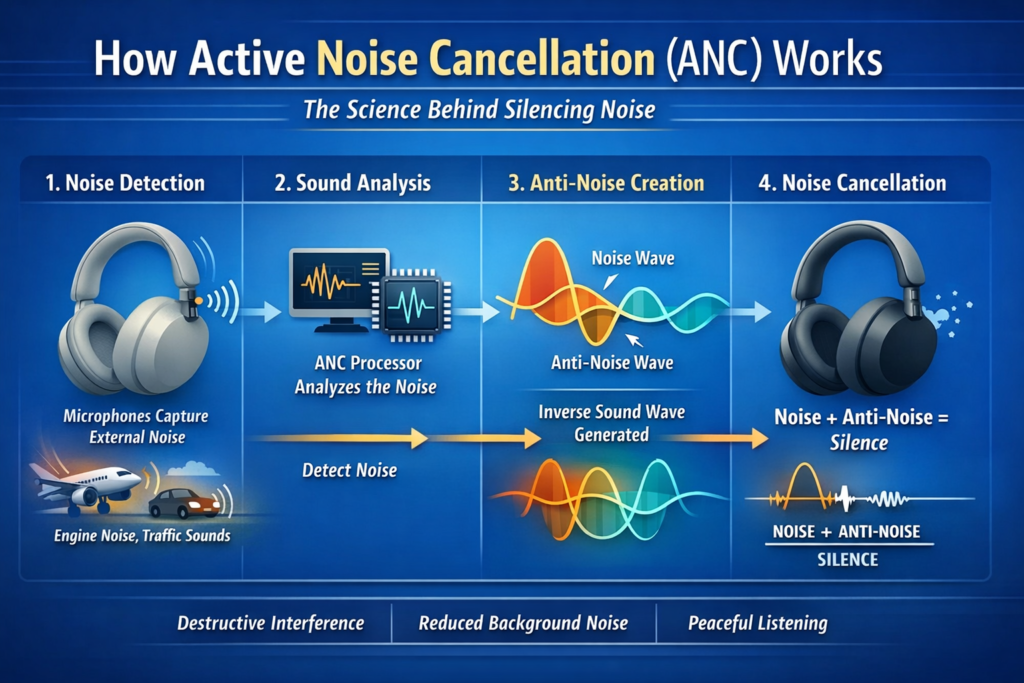
ANC works on a simple scientific principle: Sound waves can cancel each other out.
Here’s how it works step-by-step:
- Microphones detect external noise
Tiny microphones on the headphones pick up surrounding sounds (like airplane engines or traffic). - The processor analyzes the sound
The internal chip instantly analyzes the frequency and amplitude of that noise. - Inverse sound wave is created
The headphones generate a sound wave that is the exact opposite (anti-phase) of the unwanted noise. - Noise gets canceled
When the original sound and the opposite sound meet, they cancel each other out. This is called destructive interference.
As a result, you hear much less background noise.
Types of Active Noise Cancellation
1. Feedforward ANC
- Microphone placed outside the ear cup
- Detects external noise before it reaches your ears
- Good for consistent background noise
2. Feedback ANC
- Microphone placed inside the ear cup
- Adjusts cancellation based on what you actually hear
- More accurate correction
3. Hybrid ANC
- Combines both feedforward and feedback microphones
- Provides the best overall noise cancellation
- Found in premium headphones
What Kind of Noise Can ANC Block?
ANC works best for:
✅ Low-frequency sounds (airplane engines, AC noise, traffic hum)
⚠️ Less effective for sudden high-pitched sounds (people talking, horns, babies crying)
That’s because low-frequency sounds are more predictable and easier to cancel electronically.
Benefits of Noise Cancellation
- Better music clarity
- Improved focus while working
- Reduced stress during travel
- Clearer voice calls
- Lower listening volumes (protects hearing)
Does Noise Cancellation Drain Battery?
Yes. Active Noise Cancellation requires power to run microphones and processors. So ANC headphones usually have:
- Rechargeable batteries
- Slightly reduced battery life when ANC is ON
For example, premium ANC headphones can last 20–40 hours depending on usage.
Is Noise Cancellation Worth It?
If you:
- Travel frequently
- Work in noisy environments
- Study in crowded places
- Want immersive music experience
Then yes, noise cancellation is absolutely worth it.
However, if you mainly use headphones at home in a quiet room, passive isolation may be enough.
Final Thoughts
Noise cancellation is one of the most impressive audio technologies available today. By using advanced sound wave science and smart processors, ANC headphones create a peaceful listening environment even in noisy surroundings.
Whether you’re commuting, working remotely, or relaxing with music, noise cancellation can completely transform your audio experience.