What Is OIS? Optical Image Stabilization Explained in Detail
There is a moment every photographer and videographer knows well. You raise your camera or smartphone, frame a perfect shot, press the shutter — and the result is a blurry, smeared image that looks nothing like what your eyes saw. Or you record a video that, when played back, bounces and judders with every tiny hand tremor. The subject looked sharp. The light seemed adequate. But the image is ruined.
The culprit is camera shake — the unavoidable, involuntary movement of your hands, your body, and the device itself during the fraction of a second the camera needs to capture light. And the technology that fights back against it, that works silently inside billions of cameras and smartphones right now, is called Optical Image Stabilization, or OIS.
OIS is one of the most impactful technologies in modern photography and videography, yet it is also one of the most misunderstood. It is frequently confused with digital stabilization. Its mechanisms are rarely explained beyond vague marketing language. And its real-world benefits — and real-world limitations — are poorly communicated in nearly every smartphone spec sheet.
This guide changes that. We will go from the physics of why camera shake happens and why it destroys images, through the precise mechanical and optical engineering of how OIS works, through the different types and implementations, through the comparison with competing stabilization methods, and finally to a clear-eyed assessment of what OIS actually delivers in the real world and what it cannot do.
Part One: The Problem — Why Camera Shake Destroys Images
Light, Time, and Motion
Photography is the art of capturing light. When you take a photograph, the camera’s shutter opens for a specific duration — the shutter speed or exposure time — allowing light to hit the image sensor and build up a signal. During this time, the sensor is recording whatever light is falling on it.
Here is the problem: if the camera moves during this exposure time, even slightly, the image of the scene shifts across the sensor. Instead of a static pattern of light precisely mapped to sensor pixels, you get a smeared trail of light — different parts of the scene projected onto the same pixel at different moments. The result is motion blur: sharp edges become soft, fine details dissolve, text becomes unreadable, and faces lose their definition.
The critical insight is that the amount of blur depends on both how much the camera moves and how long the shutter is open. At a fast shutter speed of 1/1000th of a second, even a relatively large hand tremor produces negligible blur because there is simply not enough time for the image to shift significantly. But at slower shutter speeds — 1/60th of a second, 1/30th, 1/15th, or longer — the same amount of hand tremor produces significant, visible blur.
Why Slow Shutter Speeds Are Unavoidable
You might wonder: if fast shutter speeds prevent blur, why not always shoot at 1/1000th of a second? The answer is that shutter speed is directly tied to light. Faster shutter speeds let in less light. In bright sunlight, 1/1000th of a second is perfectly adequate. But in a dim restaurant, at dusk, indoors, at a concert, or in any low-light environment, using such a fast shutter speed would result in a grossly underexposed, near-black image.
To get a properly exposed image in low light, the camera must use a slower shutter speed to allow more light to accumulate on the sensor. And slower shutter speeds mean more time for camera shake to cause blur. This is the fundamental tension at the heart of low-light photography — and it is why OIS matters most precisely when photography is most challenging: in low light.
The Physics of Human Hand Tremor
Human hands are never perfectly still. Even the steadiest hand trembles with micro-vibrations caused by heartbeat, breathing, muscle micro-contractions, and neurological signals. These involuntary tremors are small — typically in the range of 1–3 degrees of angular movement for a handheld camera — but they occur at frequencies of roughly 8–20 Hz (cycles per second) and are perfectly capable of producing significant image blur at slow shutter speeds.
At a focal length of 50mm, a 1-degree rotation of the camera corresponds to a shift of the image by roughly 0.87mm at the sensor plane of a full-frame camera. At slow shutter speeds, this shift happens multiple times during the exposure, producing blur that extends across many pixels and visibly degrades image quality.
The severity of camera shake also scales with focal length. A telephoto lens magnifies both the subject and any camera movement — a slight tremor that is invisible at a 24mm wide-angle lens becomes obvious and blurring at a 200mm telephoto lens. This is why the traditional “reciprocal rule” of photography suggests using a shutter speed at least as fast as 1/focal length: at 200mm, avoid shutter speeds slower than 1/200th of a second.
The Stakes in the Modern Era
Smartphones have made this problem more acute in several ways. Smartphone cameras use very small sensors, which require physically longer equivalent focal lengths (in terms of angle of view) while maintaining tiny physical dimensions — meaning even the “standard” lens on a smartphone has optical characteristics that make shake more impactful than a DSLR equivalent. Periscope telephoto lenses on modern smartphones achieving 5×, 10×, or even 100× zoom magnify shake to extreme degrees. And smartphones are held in ways that are inherently less stable than cameras braced against the eye and supported with both hands.
Part Two: What Is Optical Image Stabilization?
The Core Concept
Optical Image Stabilization (OIS) is a hardware-based stabilization system that physically compensates for camera shake by moving an optical element or the image sensor in the opposite direction of detected movement, in real time, during the exposure. By counteracting the camera’s motion at the optical or sensor level, the image projected onto the sensor remains stationary even while the camera itself is moving.
The word optical is crucial. OIS operates within the optical path of the camera — it moves physical glass or the physical sensor. This distinguishes it from digital stabilization (also called electronic image stabilization, or EIS), which crops and shifts the image after it has been captured, using software rather than hardware. We will compare these approaches in detail later.
The Key Components
Every OIS system requires three fundamental components working together:
Motion sensors (gyroscopes) detect the camera’s movement. Modern OIS systems use MEMS gyroscopes (Microelectromechanical Systems) — tiny semiconductor devices that can measure angular velocity (rotational movement) with extraordinary precision and speed. A typical OIS gyroscope samples the camera’s motion hundreds to thousands of times per second, providing a continuous, real-time stream of movement data.
A compensation mechanism physically moves an optical element or the sensor in response to the gyroscope data. This is the mechanical heart of OIS and where different implementations diverge significantly.
A control system processes the gyroscope data, calculates the required compensation movement, and drives the compensation mechanism with the correct speed, direction, and magnitude to counteract the detected shake. This is a sophisticated real-time control loop running continuously throughout the exposure.
How the Control Loop Works
The operation of OIS can be understood as a continuous feedback loop:
The gyroscopes detect angular movement of the camera — say, a 0.2-degree tilt to the right occurring over 5 milliseconds. The control system calculates what this angular movement means for the position of the image on the sensor: the image is shifting to the right by a specific number of micrometers. The control system commands the actuators to move the compensation element by an equal and opposite amount — shifting the image back to its original position on the sensor. The gyroscopes detect the next moment of movement and the cycle repeats, hundreds of times per second throughout the entire exposure.
The result is that despite the camera moving continuously in the photographer’s unsteady hands, the image on the sensor remains effectively stationary. The light from the scene traces the same pixels throughout the exposure rather than smearing across multiple pixels. The image is sharp.
Part Three: Types of OIS — How Different Systems Work
There are several distinct mechanical approaches to implementing OIS, each with different engineering trade-offs.
Lens-Shift OIS (Moving the Lens Element)
The most common implementation in dedicated cameras (DSLRs, mirrorless cameras, and many compact cameras) is lens-shift OIS, where a floating lens element inside the optical assembly is moved perpendicular to the optical axis to compensate for camera movement.
In a typical lens-shift OIS system, one or more lens elements are mounted in a floating frame suspended by a combination of springs or flexible bearings and driven by electromagnetic actuators — typically voice coil motors (VCMs), which use the interaction between an electromagnet and a permanent magnet to produce precise, controlled linear movement.
When the gyroscope detects upward camera movement, the voice coil motors push the floating lens element slightly downward. This shifts the angle of the light entering the lens, projecting a different portion of the scene onto the sensor — specifically the portion that compensates for the upward camera movement. To the sensor, the image appears to have remained stationary.
Lens-shift OIS is mechanically elegant because it can be built into the lens itself (Canon and Nikon’s in-lens stabilization systems for their DSLR lenses, for example) or combined with in-body systems for dual stabilization. The trade-off is that each lens requires its own stabilization mechanism, adding cost and complexity to the lens rather than the body.
Sensor-Shift OIS (Moving the Image Sensor)
Sensor-shift OIS (also called IBIS — In-Body Image Stabilization — when implemented in a camera body) moves the image sensor itself rather than a lens element. The sensor is mounted on a floating platform driven by electromagnetic actuators, and the entire sensor shifts in response to detected camera movement.
The physics are equivalent to lens-shift OIS — both keep the projected image stationary on the sensor — but the engineering implications differ significantly:
Because the sensor (not the lens) moves, sensor-shift OIS works with any lens attached to the camera body, including older lenses with no built-in stabilization. This is a significant advantage for mirrorless camera systems like Sony’s full-frame E-mount bodies, where IBIS benefits every lens in the ecosystem.
Sensor-shift can also enable 5-axis stabilization, compensating not just for rotational pitch (up-down tilt) and yaw (left-right rotation) but also for translational movement in the X axis (horizontal translation), Y axis (vertical translation), and roll (rotation around the optical axis). Five-axis stabilization is particularly beneficial for macro photography and video, where translational shake is more significant than at normal shooting distances.
The engineering challenge of sensor-shift OIS is that moving a heavy image sensor quickly and precisely requires powerful actuators and sophisticated suspension systems. Modern camera bodies achieving IBIS (like Sony A7 series, Nikon Z series, Canon R series, and OM System cameras) are engineering marvels that can move a sensor weighing several grams with sub-micron precision at hundreds of cycles per second.
Smartphone OIS: Miniaturized Lens-Shift
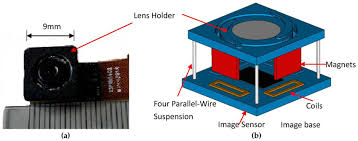
In smartphones, OIS is almost always a miniaturized lens-shift implementation. The entire camera module — lens assembly and sensor — is sealed in a tiny package, and within this package, the lens elements (or in some implementations, the entire lens and sensor assembly) are suspended on a flexible system of wires, springs, or ball bearings and driven by tiny electromagnetic actuators.
The engineering constraints of smartphone OIS are dramatically more challenging than camera OIS. The entire camera module might be 8–10mm thick and a few centimeters square. The OIS mechanism must fit within this envelope while maintaining its precision, surviving thousands of drop impacts, operating across extreme temperature ranges, and consuming minimal battery power.
The actuators used in smartphone OIS are typically voice coil motors (VCMs) — the same principle used in camera lenses but miniaturized to submillimeter precision. More recently, some implementations use shape memory alloy (SMA) actuators (wires made from materials that contract and extend with temperature changes controlled by tiny electrical currents) or piezoelectric actuators. Each technology offers different trade-offs in terms of speed, power consumption, precision, and thermal characteristics.
Sensor-Shift OIS in Smartphones (Apple iPhone 12 Pro and Later)
Apple introduced sensor-shift OIS to smartphones with the iPhone 12 Pro Max in 2020, later extending it to the standard iPhone 13 Pro and eventually all iPhone 14 models. In Apple’s implementation, the image sensor itself is mounted on a floating platform within the camera module and shifts to compensate for detected movement, using a system of tiny actuators and a suspension mechanism.
The advantages Apple claimed for sensor-shift over lens-shift in smartphones are that moving the sensor (rather than the lens) can be done with more mechanical efficiency at small scales, enables compensation across the full sensor surface simultaneously (no optical distortion at the edges from lens element movement), and allows the OIS to function across the full range of camera zoom without recalibration.
Independent analysis of iPhones with sensor-shift OIS generally confirmed improved stabilization performance, particularly for video and in challenging dynamic situations, compared to the previous lens-shift implementations.
Part Four: OIS Specifications and Performance Metrics
Stabilization Stops
OIS effectiveness is commonly measured in stops of stabilization — a logarithmic scale where each stop represents a doubling of exposure time. If an unstabilized photographer can handhold a camera without blur at 1/100th of a second at a given focal length, a 3-stop OIS system allows that same photographer to shoot at 1/12th of a second (three doublings: 1/100 → 1/50 → 1/25 → 1/12) without blur — allowing 8× more light to reach the sensor.
Entry-level OIS systems provide approximately 2 stops of stabilization. Mid-tier systems deliver 3–4 stops. Top-tier camera bodies with advanced IBIS (like the OM System OM-1 or Sony A7R V) claim up to 7–8 stops of stabilization in optimal conditions. Smartphone OIS systems typically provide approximately 3–4 stops of stabilization, with variations depending on implementation quality.
It is important to note that manufacturers’ stabilization claims are often measured under ideal conditions that may not reflect real-world performance. A 5-stop claim does not mean you can always handhold at a 5-stop slower shutter speed — it means the system can achieve this under specific, controlled testing conditions.
Stabilization Axes
The axes of stabilization describe which types of camera movement a system compensates for:
Pitch — tilting the camera up and down (nodding). This is the most common type of hand tremor and the primary axis of stabilization in even basic OIS systems.
Yaw — rotating the camera left and right (shaking the head “no”). Also very common and addressed by most OIS systems.
Roll — rotating the camera around the optical axis (like turning a key). Less common in normal photography but significant for video.
X-axis translation — sliding the camera horizontally. Significant for close-up and macro photography where even tiny translational movements have large effects on the image.
Y-axis translation — sliding the camera vertically. Similar significance to X-axis translation.
Basic OIS systems address pitch and yaw (2-axis). More sophisticated systems add roll (3-axis). Full 5-axis stabilization covers all five movements and represents the current state of the art in camera body stabilization.
Stabilization Frequency Response
OIS systems are more effective at correcting some frequencies of movement than others. Typical hand tremor occurs at 1–20 Hz — frequencies at which most OIS systems perform well. But very low-frequency, large-amplitude movements (walking, running) are beyond the physical compensation range of most OIS systems. Very high-frequency vibrations (engine vibration, certain mechanical environments) may exceed the system’s response bandwidth.
Part Five: Dual OIS and Advanced Stabilization Systems
Dual OIS (Lens + Sensor Combined)
Some cameras and smartphones combine lens-shift OIS with sensor-shift OIS in a coordinated dual system. Panasonic introduced the concept in their Lumix cameras as Dual IS (DualIS), where the lens IS and body IS communicate with each other and coordinate their compensation movements, with each system addressing the types of movement it handles most effectively. The result is stabilization performance that exceeds what either system could achieve alone.
Samsung implemented a comparable dual OIS approach in high-end Galaxy smartphones, with the lens assembly and sensor both contributing to stabilization in a coordinated way.
Gimbal-Based OIS (Vivo, Xiaomi)
Some smartphone manufacturers have implemented what they call “gimbal-style OIS” or “micro-gimbal OIS” — systems where the entire camera module (lens + sensor as a unit) is mounted on a suspension system that rotates in multiple axes, similar in concept to the motorized camera gimbals used by professional videographers. Vivo’s X50 Pro (2020) was an early prominent example.
This approach provides a qualitatively different feel of stabilization — smoother and more fluid for video, with a wider range of compensation — but requires a larger mechanical assembly and has complex engineering requirements for maintaining autofocus, aperture, and other camera functions while the module is floating.
Coordinated OIS + EIS
The most sophisticated stabilization in modern flagship smartphones combines OIS for optical correction with EIS (Electronic Image Stabilization) for residual correction and smoothing. OIS handles the physical camera shake while EIS uses the remaining image buffer (shooting at slightly wider field of view and cropping to the target output) to smooth out residual micro-jitter that OIS cannot fully correct. Google’s Pixel phones call this combination “Cinematic Stabilization” or “Locked Stabilization.” Apple calls similar functionality “Action Mode.” The results are video stabilization that approaches gimbal quality without requiring any external hardware.
Part Six: OIS vs. EIS vs. IBIS — Understanding All Stabilization Methods
Electronic Image Stabilization (EIS) — Digital Stabilization
EIS works fundamentally differently from OIS. Rather than moving hardware to keep the image stationary on the sensor during capture, EIS captures a slightly wider image than the target output, then uses the gyroscope data and software algorithms to digitally crop and shift the recorded frames, compensating for shake after the fact.
If the camera tilts right by 2 pixels during a video frame, EIS shifts the crop window 2 pixels to the left, effectively canceling the movement in the output video. Over successive frames, this produces smooth, stabilized video from shaky raw footage.
Advantages of EIS: It requires no moving parts and is therefore extremely reliable, adds no weight, consumes minimal power, and costs almost nothing to implement in software. It can be continuously improved through software updates. It can compensate for very large movements that would exceed the physical range of any OIS actuator.
Disadvantages of EIS: Since EIS works by cropping the image, it reduces the field of view — you lose the edges of the frame. In video, this creates a slight “zoomed in” appearance compared to an equivalent OIS-stabilized frame. More critically, EIS cannot reduce motion blur within individual frames — if the shutter was open long enough for camera shake to cause blur, EIS cannot remove that blur after the fact. OIS, by keeping the image stationary on the sensor during exposure, prevents the blur from ever occurring. This makes OIS fundamentally superior for still photography and for video shot in low light (where slower shutter speeds are needed).
In-Body Image Stabilization (IBIS)
IBIS is sensor-shift OIS implemented in the camera body rather than the lens. It is OIS — not a different technology — but the term is used specifically in the context of mirrorless and DSLR cameras to distinguish body-based stabilization from lens-based stabilization. IBIS is optical stabilization and shares all the advantages and limitations of OIS generally.
The Hierarchy: Which Is Best?
For still photography in low light: OIS (lens-shift or sensor-shift) is superior to EIS because it prevents blur at the point of capture.
For video in good light: EIS can be competitive with OIS and sometimes preferred because software can achieve very smooth, large-range stabilization without any physical mechanism.
For video in low light: OIS is superior because it allows slower shutter speeds without blur.
For maximum performance: Combined OIS + EIS (as implemented in flagship smartphones) achieves the best results by leveraging the complementary strengths of both approaches.
For versatility: IBIS (sensor-shift in camera bodies) is the most flexible for photographers who use many different lenses, as every lens benefits regardless of whether it has built-in stabilization.
Part Seven: OIS in Specific Camera Categories
OIS in Smartphones
Smartphone OIS has become a standard feature in mid-range and premium devices, and is increasingly appearing in budget tier phones as manufacturing costs decline. Key considerations for smartphone OIS include:
Main camera OIS is nearly universal in flagships. The physical sensor size and aperture of the main camera make OIS particularly impactful here.
Ultrawide camera OIS is less common but increasingly included in premium flagships. Ultrawide lenses (typically 13–16mm equivalent) are less prone to camera shake at baseline but become critical for video recording where shake at any focal length is noticeable.
Telephoto camera OIS is essential and arguably the most impactful application of OIS in smartphones. A 5× telephoto lens magnifies both subject and camera shake by 5×, making OIS effectiveness directly proportional to zoom level. Periscope telephoto modules (achieving 5× to 10×+ optical zoom) typically incorporate more sophisticated OIS systems specifically to address the extreme shake amplification at high zoom.
Video-specific OIS modes in flagship smartphones often engage a more aggressive OIS compensation range for video recording, sometimes in combination with EIS for maximum smoothness.
OIS in Consumer Compact Cameras
Virtually all consumer compact cameras include OIS (typically marketed as “Optical SteadyShot” by Sony, “IS” by Canon, “MEGA O.I.S.” by Panasonic, or “VR” by Nikon). These systems are typically 3–5 axis, providing 3–5 stops of stabilization, and are essential for handheld photography with the zoom ranges these cameras offer.
OIS in Interchangeable Lens Cameras (ILC)
In DSLRs and mirrorless cameras, OIS can be implemented in the lens, the body, or both:
Canon has traditionally implemented IS in the lens, with most L-series and many consumer lenses featuring optical stabilization. Canon EOS R bodies now offer IBIS that coordinates with lens IS for combined performance.
Nikon implements VR (Vibration Reduction) in lenses, with IBIS added to higher-end Z series mirrorless bodies. Coordinated Synchro VR between lens VR and body VR provides enhanced performance.
Sony implements IBIS in its full-frame A7 and A9 bodies, with some lenses adding their own OSS (Optical SteadyShot) that coordinates with the body.
OM System (formerly Olympus) has long been a leader in IBIS for Micro Four Thirds cameras. The OM-1 and OM-5 claim up to 7–8 stops of combined stabilization — among the most effective in the industry — partly enabled by the smaller, lighter MFT sensor that can be moved with less force.
OIS in Action Cameras and Drones
GoPro and similar action cameras use a combination of hardware OIS and sophisticated EIS to achieve the “HyperSmooth” stabilization that has become synonymous with the brand. The mechanical challenges of stabilizing a camera that is being strapped to a helmet, mounted on a handlebars, or attached to a surfboard require stabilization systems that handle movements far beyond typical hand tremor.
Drone cameras use physical gimbals — motorized platforms that keep the camera level regardless of the drone’s orientation — combined with electronic stabilization for fine correction. DJI’s three-axis stabilization gimbals are industry-leading examples.
Part Eight: Real-World OIS Performance — What to Expect
What OIS Genuinely Improves
Low-light still photography is the primary beneficiary. OIS allows photographers to use 3–5× slower shutter speeds without camera shake blur, dramatically improving exposure in dim conditions without needing to raise ISO (which introduces noise) or use flash.
Telephoto photography benefits enormously. At 5× zoom or beyond, OIS is not a luxury — it is essentially a requirement for consistently sharp handheld shots.
Video smoothness improves significantly, particularly for slow, walking shots. OIS removes the micro-jitter of hand tremor from video, making handheld footage look substantially more intentional and professional.
Burst photography benefits because the first shot in a burst is more likely to be sharp (the camera has not yet settled after autofocus adjustment).
Night mode photography (multi-frame long exposure compositing) is dramatically improved by OIS because holding the camera still for the 1–3 seconds of a night mode capture is far easier with OIS suppressing shake.
What OIS Cannot Do
Freeze fast-moving subjects. OIS stabilizes the camera relative to the scene — it cannot prevent blur caused by subject movement. A running child, a moving car, or a bird in flight will still be blurry if the shutter speed is too slow, regardless of how good the OIS is. Subject motion requires a fast shutter speed; OIS is irrelevant to this problem.
Compensate for walking or running movement. The rhythmic, large-amplitude movement of walking produces shifts far beyond the physical compensation range of lens or sensor-based OIS. Walking video (without gimbal or advanced EIS) still shows noticeable bobbing and weaving. EIS can smooth walking movement better than OIS alone; a physical gimbal handles it best.
Eliminate all shake at extreme shutter speeds. At 1/2 second or longer handheld, even excellent OIS systems face limitations. The cumulative amount of movement over such a long exposure can exceed the physical range of the actuators.
Replace a tripod for long exposures. For truly long exposures — 1 second, 5 seconds, 30 seconds — a tripod is the only solution. OIS provides no meaningful help at these time scales.
Improve images in bright light. If you are shooting at 1/2000th of a second in sunlight, camera shake is not an issue regardless of OIS. OIS makes no difference to images where shutter speed is already fast enough to freeze any camera movement.
Part Nine: The Future of OIS Technology
Larger Physical Compensation Range
One of the primary engineering directions is increasing the physical range over which OIS can compensate — allowing correction of larger, slower movements that current systems cannot address. This involves more powerful actuators, better suspension systems, and more sophisticated control algorithms.
AI-Enhanced Predictive Stabilization
Current OIS systems are reactive — they detect movement and correct for it. Next-generation systems are incorporating AI-based predictive algorithms that can anticipate movement patterns (recognizing the rhythmic frequency of walking, for instance) and pre-position the compensation element before the predicted movement occurs. This reduces the lag between movement and correction, improving stabilization quality particularly for rhythmic or predictable motions.
Electromagnetic Suspension
Some manufacturers are developing electromagnetic suspension systems that replace mechanical springs and bearings with controlled magnetic fields, providing frictionless, near-instantaneous response and potentially eliminating the mechanical wear that eventually degrades OIS systems over time.
Integration with Computational Photography
The future of stabilization is increasingly not OIS alone or EIS alone, but deep integration between hardware stabilization, sensor readout speed, AI-based scene analysis, and multi-frame computational techniques. Systems that analyze scene content, identify the most critical elements to keep sharp, and combine multiple stabilization methods dynamically represent the direction the most advanced cameras are heading.
Conclusion: OIS Is Engineering in Service of a Human Limitation
Optical Image Stabilization exists because human hands are never still and because the physics of light capture demand exposure times that make that involuntary movement visible in photographs and video. It is a technology that takes an unavoidable biological limitation — the trembling of human muscles — and neutralizes it with precision engineering working at speeds and scales invisible to the human eye.
From the MEMS gyroscope sampling movement a thousand times per second, to the voice coil motor responding in milliseconds, to the control algorithm calculating compensations in real time, OIS is a remarkable convergence of physics, materials science, electronics, and software working in concert to give every photographer — professional or casual, camera or smartphone — the ability to capture sharp images in conditions that previously required a tripod or flash.
It does not solve every problem. It cannot freeze a moving subject. It cannot replace a gimbal for walking video. It cannot substitute for a tripod in true long-exposure photography. But within its domain — eliminating the blur caused by the camera operator’s own movement during the exposure — it is one of the most consistently impactful technologies in the history of photography.
Understanding OIS means understanding both what it can do for you and what it cannot. It means knowing when to rely on it, when to supplement it with a physical support or gimbal, and when to engage it fully and trust the invisible mechanical ballet happening inside your lens or camera body to deliver the sharp, clear image your eye saw and your hand was too human to hold still enough to capture on its own.