In 2026, when you make a regular phone call on your smartphone in Pakistan, there’s a good chance it’s using VoLTE — especially if you’re on Jazz, Zong, Telenor, or Ufone and have a compatible 4G handset. But what exactly is VoLTE, how does it differ from traditional calls, and why has it become the standard for voice communication in the 4G (and now 5G) era?
In this detailed blog post, we’ll cover everything: what VoLTE stands for, how it technically works, its major advantages and disadvantages, how to enable it (with Pakistan-specific notes), and its role as networks evolve toward 5G.
What Does VoLTE Stand For?
VoLTE stands for Voice over Long-Term Evolution (or Voice over LTE).
It’s the technology that allows you to make voice calls over a 4G LTE network (and compatible 5G networks) instead of falling back to older 2G or 3G networks for calls.
Before VoLTE:
- 4G was great for fast internet (browsing, YouTube, WhatsApp).
- But when you made or received a call, your phone switched to 2G/3G → data paused, call quality was average, setup was slow.
VoLTE changed that by treating voice calls as data packets over the same high-speed LTE network you use for everything else.
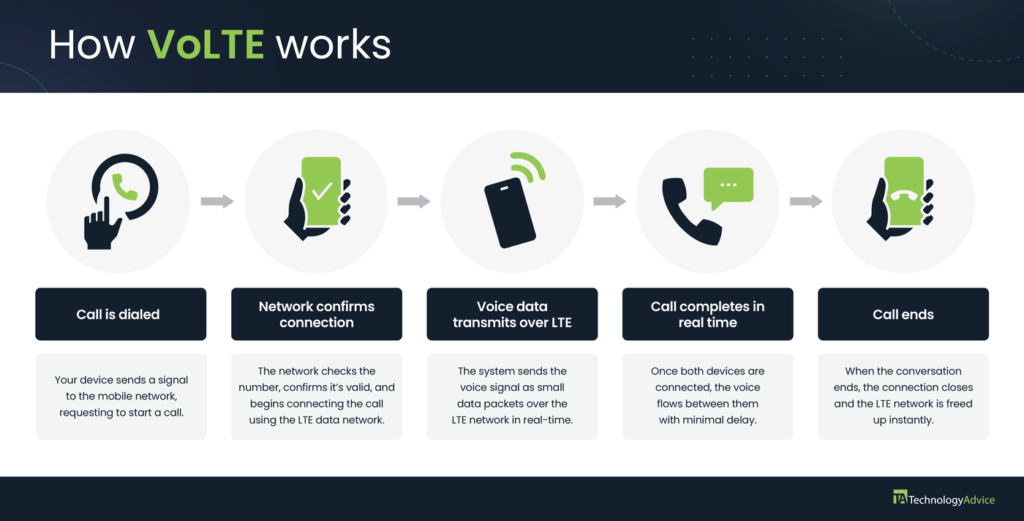
How Does VoLTE Work?
VoLTE uses packet-switched technology (like internet data) rather than the old circuit-switched method of 2G/3G.
Here’s the step-by-step breakdown:
- Voice to Data Conversion
Your voice is captured by the microphone, compressed using advanced codecs (like AMR-WB for HD Voice or EVS for even better quality), and turned into digital IP packets. - IP Multimedia Subsystem (IMS)
VoLTE relies on the IMS framework (a standard set by 3GPP). IMS handles call setup, routing, and features like call waiting, conferencing, and video calling over LTE. - Transmission Over LTE
These voice packets travel over the same 4G LTE data bearer (connection) as your WhatsApp messages or YouTube stream. No separate voice channel is needed. - Call Setup & Quality
Because everything is IP-based, call setup is much faster (often 1–2 seconds vs. 5–10 seconds on 3G). Audio is transmitted in HD (wider frequency range → clearer, more natural sound). - Handover & Fallback
If you move to an area with no 4G coverage, the call can seamlessly fall back to 3G/2G (CSFB – Circuit-Switched Fallback), though modern networks minimize this.
In short: VoLTE turns your voice call into internet-like data packets, sent over the same fast 4G/5G connection.
Key Advantages of VoLTE
VoLTE brings real, noticeable improvements over traditional calls:
- HD Voice Quality — Clearer calls with richer sound (less muffled, better background noise handling). Both caller and receiver need VoLTE support for full HD.
- Faster Call Setup — Calls connect almost instantly (1–3 seconds typical).
- Simultaneous Voice + Data — Browse the internet, use WhatsApp, Google Maps, or stream music while on a call — no more “data paused” messages.
- Better Battery Life — Phone doesn’t need to switch radios (2G/3G ↔ 4G) constantly; stays on LTE → less power drain.
- More Efficient Network Use — Operators can handle more calls per cell tower; supports advanced features like video calling over LTE (ViLTE) and Wi-Fi calling (VoWiFi).
- Future-Proof — As 2G/3G networks are phased out globally (and in Pakistan gradually), VoLTE (and later VoNR for 5G) becomes essential.
Disadvantages & Limitations of VoLTE
It’s not perfect — here are the main drawbacks:
- Device & SIM Compatibility — Needs a VoLTE-capable phone and a 4G USIM (most modern phones post-2016 support it).
- Network Coverage Dependency — If 4G signal is weak, call quality drops or falls back to 3G/2G.
- Operator Support Required — Both caller and receiver’s networks must support VoLTE for full benefits (cross-network HD works in many cases now).
- Initial Battery Drain in Poor Areas — If the phone struggles to maintain LTE for voice, it can consume more power.
- Not Universal Yet in All Regions — In rural Pakistan or during travel, fallback to 2G/3G still happens.
VoLTE in Pakistan (March 2026 Update)
Good news for users in Peshawar and across Khyber Pakhtunkhwa/Pakistan:
Major operators have rolled out VoLTE nationwide or in large parts:
- Jazz — VoLTE available across Pakistan; works on compatible handsets for both prepaid and postpaid. Jazz is pushing hard with converged voice cores for better adoption.
- Zong — Actively promoting VoLTE with HD voice + simultaneous data; enable in settings.
- Telenor — Supports VoLTE and VoWiFi in many areas.
- Ufone — Launched VoLTE years ago; available on selected handsets, with ongoing improvements.
To check/enable VoLTE on your phone (Android/iPhone):
- Go to Settings > Mobile Network / Connections > VoLTE Calls (or similar wording).
- Toggle it ON.
- Dial ##4636## (Android) or check carrier settings on iPhone.
- Look for “4G Calling” or “VoLTE” indicator next to signal bars during a call.
Most flagship and mid-range phones from Samsung, Xiaomi, Infinix, Tecno, iPhone (iOS 14+), etc., support it in Pakistan.
The Future: VoLTE to VoNR (Voice over New Radio)
As Pakistan prepares for 5G (spectrum auction happened March 2026, commercial launches expected mid-2026 onward), VoLTE will evolve into VoNR (Voice over 5G NR). The same IP-based principles apply, but with even lower latency, better quality, and full 5G integration.
Final Thoughts
VoLTE is no longer a “nice-to-have” — it’s the modern standard for making phone calls in 2026. It delivers clearer audio, faster connections, and the freedom to multitask during calls, all while preparing networks for the 5G future.
If your phone shows “VoLTE” or “HD” during calls, you’re already enjoying it. If not, check your settings, ensure your SIM is 4G-enabled, and contact your operator (Jazz, Zong, etc.) — it’s usually free to activate!
Have you noticed better call quality since enabling VoLTE? Which network are you on in Peshawar? Share your experience in the comments!